Architectural Exaptation
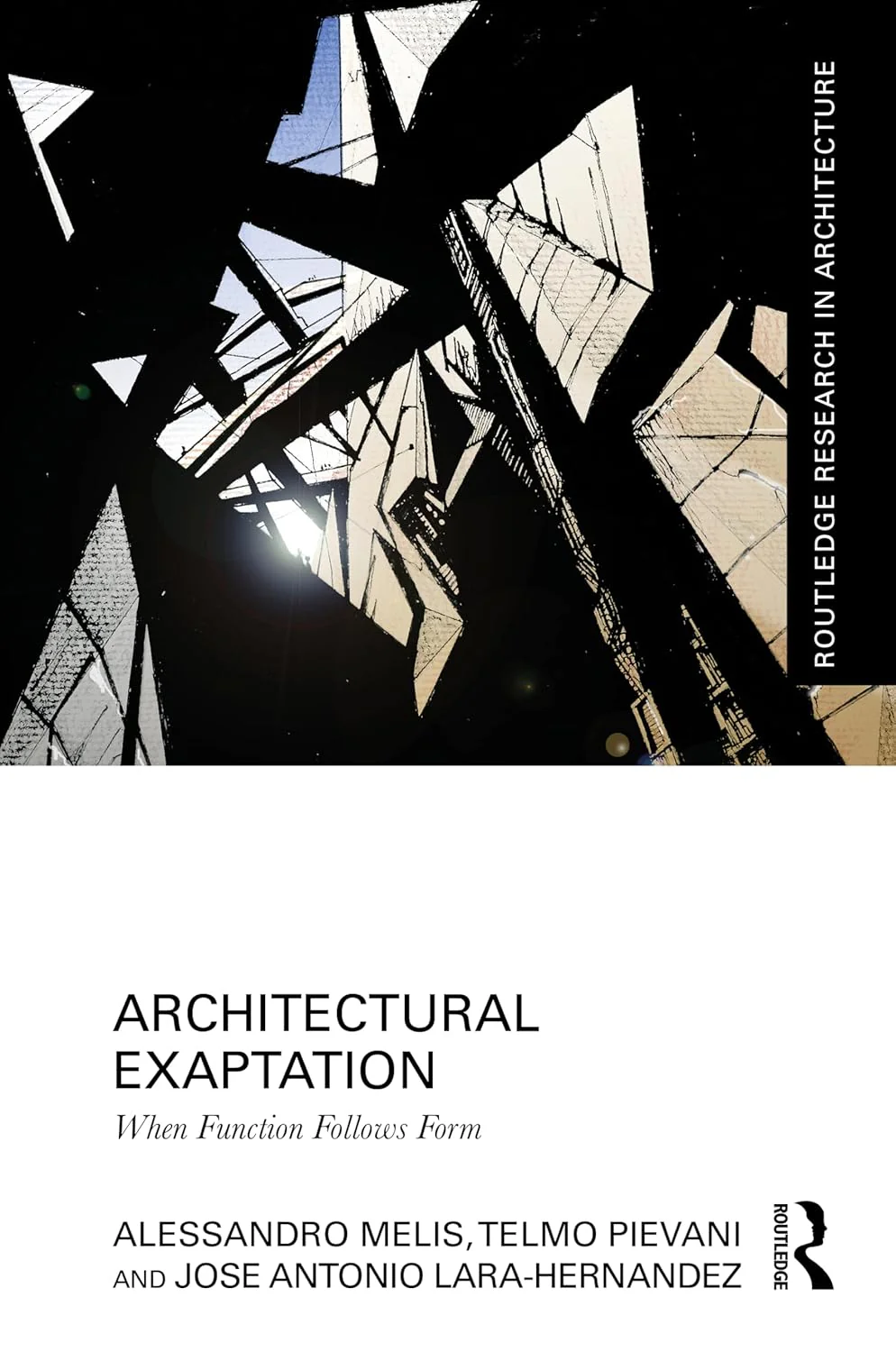
Architectural Exaptation: When Function Follows Form focuses on the significance and originality of the study of exaptation. It presents exaptation as an opportunity to extend architectural design towards more sustainable approaches aimed at enforcing urban resilience.
The use of exaptation’s definition in architecture supports the heuristic value of cross-disciplinary studies on biology and architecture, which seem even more relevant in times of global environmental crises. This book critiques the pre-existing and extensive paternalistic literature. Exaptation is described as a functional shift of a structure that already had a prior, but different, function.
In architecture, a functional shift of a structure that already had a function may apply to forms of decorative elements embedded in architectural components and to both the change of function of tectonic elements and the change of use of an architectural space. The book is illustrated with examples from around the globe, including China, Italy, Mexico, New Zealand, the USA, and the UK. It looks at different civilizations and diverse historical periods, ranging from the urban to the architectural scale. Such examples highlight the potential and latent human creative capacity to change the use and functions, something that cities and buildings could consider when facing disturbances.
Exaptation is shown as an alternative narrative to the simplifications of evolutionary puritanism. It offers an innovative perspective and presents an opportunity to re-think the manner in which we design and redesign our cities.
This book will interest researchers and students in architecture, planning, urban design, and biology.
Winner of the ‘Gerd Albers Award 2024’. This award recognises the best book contribution in the field of Urban Planning and is awarded by the International Society of City and Regional Planners (ISOCARP).
Architectural Exaptation: When Function Follows Form focuses on the significance and originality of the study of exaptation. It presents exaptation as an opportunity to extend architectural design towards more sustainable approaches aimed at enforcing urban resilience.
The use of exaptation’s definition in architecture supports the heuristic value of cross-disciplinary studies on biology and architecture, which seem even more relevant in times of global environmental crises. This book critiques the pre-existing and extensive paternalistic literature. Exaptation is described as a functional shift of a structure that already had a prior, but different, function.
In architecture, a functional shift of a structure that already had a function may apply to forms of decorative elements embedded in architectural components and to both the change of function of tectonic elements and the change of use of an architectural space. The book is illustrated with examples from around the globe, including China, Italy, Mexico, New Zealand, the USA, and the UK. It looks at different civilizations and diverse historical periods, ranging from the urban to the architectural scale. Such examples highlight the potential and latent human creative capacity to change the use and functions, something that cities and buildings could consider when facing disturbances.
Exaptation is shown as an alternative narrative to the simplifications of evolutionary puritanism. It offers an innovative perspective and presents an opportunity to re-think the manner in which we design and redesign our cities.
This book will interest researchers and students in architecture, planning, urban design, and biology.
Winner of the ‘Gerd Albers Award 2024’. This award recognises the best book contribution in the field of Urban Planning and is awarded by the International Society of City and Regional Planners (ISOCARP).
Original: $196.56
-65%$196.56
$68.80Description
Architectural Exaptation: When Function Follows Form focuses on the significance and originality of the study of exaptation. It presents exaptation as an opportunity to extend architectural design towards more sustainable approaches aimed at enforcing urban resilience.
The use of exaptation’s definition in architecture supports the heuristic value of cross-disciplinary studies on biology and architecture, which seem even more relevant in times of global environmental crises. This book critiques the pre-existing and extensive paternalistic literature. Exaptation is described as a functional shift of a structure that already had a prior, but different, function.
In architecture, a functional shift of a structure that already had a function may apply to forms of decorative elements embedded in architectural components and to both the change of function of tectonic elements and the change of use of an architectural space. The book is illustrated with examples from around the globe, including China, Italy, Mexico, New Zealand, the USA, and the UK. It looks at different civilizations and diverse historical periods, ranging from the urban to the architectural scale. Such examples highlight the potential and latent human creative capacity to change the use and functions, something that cities and buildings could consider when facing disturbances.
Exaptation is shown as an alternative narrative to the simplifications of evolutionary puritanism. It offers an innovative perspective and presents an opportunity to re-think the manner in which we design and redesign our cities.
This book will interest researchers and students in architecture, planning, urban design, and biology.
Winner of the ‘Gerd Albers Award 2024’. This award recognises the best book contribution in the field of Urban Planning and is awarded by the International Society of City and Regional Planners (ISOCARP).