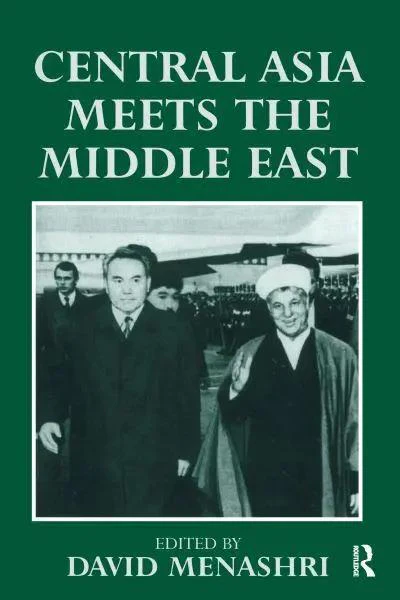
Central Asia Meets the Middle East
The six newly independent Muslim republics of the former Soviet Union — Uzbekistan, Tajikistan, Turkmenistan, Kyrgyzstan, Kazakhstan and Azerbaijan — have redefined the Middle East, creating a region of great interest for both the international community and the neighbouring states who have had to adjust their policies to the possible ramifications, new opportunities and novel challenges.
The emergence of the Muslim republics has been part of a larger transformation experienced by the Middle East in the last decade. The fall of the Soviet Union and the end of the Cold War, the 1991 Gulf War, the Arab-Israeli peace process, and the emergence of Islamic radicalism have all combined to produce what has been termed a 'New Middle East'. The newly independent states have had to consolidate themselves and evolve in a reality still only partially understood.
The main purpose of this volume is to examine the impact of that transformation on the Middle East, with special emphasis placed on the republics' relations with Turkey and Iran — the two countries closest to and most actively involved in the Muslim republics of Central Asia and Transcaucasia.
The ability of Middle Eastern states to influence the republics is still questionable — regional relationships between the Middle East and Central Asia have (re)emerged only in the 1990s — but their independence has had profound implications for the Middle East itself.
Central Asia Meets the Middle East delves into these complex dynamics, offering a comprehensive analysis of the evolving regional interactions.
The six newly independent Muslim republics of the former Soviet Union — Uzbekistan, Tajikistan, Turkmenistan, Kyrgyzstan, Kazakhstan and Azerbaijan — have redefined the Middle East, creating a region of great interest for both the international community and the neighbouring states who have had to adjust their policies to the possible ramifications, new opportunities and novel challenges.
The emergence of the Muslim republics has been part of a larger transformation experienced by the Middle East in the last decade. The fall of the Soviet Union and the end of the Cold War, the 1991 Gulf War, the Arab-Israeli peace process, and the emergence of Islamic radicalism have all combined to produce what has been termed a 'New Middle East'. The newly independent states have had to consolidate themselves and evolve in a reality still only partially understood.
The main purpose of this volume is to examine the impact of that transformation on the Middle East, with special emphasis placed on the republics' relations with Turkey and Iran — the two countries closest to and most actively involved in the Muslim republics of Central Asia and Transcaucasia.
The ability of Middle Eastern states to influence the republics is still questionable — regional relationships between the Middle East and Central Asia have (re)emerged only in the 1990s — but their independence has had profound implications for the Middle East itself.
Central Asia Meets the Middle East delves into these complex dynamics, offering a comprehensive analysis of the evolving regional interactions.
Original: $46.11
-65%$46.11
$16.14Description
The six newly independent Muslim republics of the former Soviet Union — Uzbekistan, Tajikistan, Turkmenistan, Kyrgyzstan, Kazakhstan and Azerbaijan — have redefined the Middle East, creating a region of great interest for both the international community and the neighbouring states who have had to adjust their policies to the possible ramifications, new opportunities and novel challenges.
The emergence of the Muslim republics has been part of a larger transformation experienced by the Middle East in the last decade. The fall of the Soviet Union and the end of the Cold War, the 1991 Gulf War, the Arab-Israeli peace process, and the emergence of Islamic radicalism have all combined to produce what has been termed a 'New Middle East'. The newly independent states have had to consolidate themselves and evolve in a reality still only partially understood.
The main purpose of this volume is to examine the impact of that transformation on the Middle East, with special emphasis placed on the republics' relations with Turkey and Iran — the two countries closest to and most actively involved in the Muslim republics of Central Asia and Transcaucasia.
The ability of Middle Eastern states to influence the republics is still questionable — regional relationships between the Middle East and Central Asia have (re)emerged only in the 1990s — but their independence has had profound implications for the Middle East itself.
Central Asia Meets the Middle East delves into these complex dynamics, offering a comprehensive analysis of the evolving regional interactions.