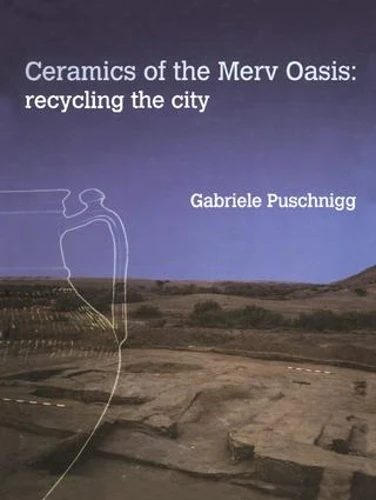
Ceramics of the Merv Oasis
Our knowledge of many groups or periods has benefited from systematic ceramic analysis; however, as yet the Sasanian Empire of ancient Persia (224-651 AD) has not been subjected to the same examination.
Merv, an expansive ancient city located in an oasis in the Central Asian steppes, was for millennia a gateway for travellers and traders along the Silk Road between east and west. Ceramics of the Merv Oasis, Puschnigg’s detailed study of Merv’s Sasanian pottery, creates a benchmark for other work on this ceramic corpus.
She dissects the frequency, dates, wares, and profiles of hundreds of securely excavated pieces and compares them with the finds from earlier Russian studies, generally unavailable to Western researchers. Puschnigg uses this material to provide insights into the social and economic dimensions of the Sasanian world, as well as providing researchers with a catalogue of typical shapes and wares.
Our knowledge of many groups or periods has benefited from systematic ceramic analysis; however, as yet the Sasanian Empire of ancient Persia (224-651 AD) has not been subjected to the same examination.
Merv, an expansive ancient city located in an oasis in the Central Asian steppes, was for millennia a gateway for travellers and traders along the Silk Road between east and west. Ceramics of the Merv Oasis, Puschnigg’s detailed study of Merv’s Sasanian pottery, creates a benchmark for other work on this ceramic corpus.
She dissects the frequency, dates, wares, and profiles of hundreds of securely excavated pieces and compares them with the finds from earlier Russian studies, generally unavailable to Western researchers. Puschnigg uses this material to provide insights into the social and economic dimensions of the Sasanian world, as well as providing researchers with a catalogue of typical shapes and wares.
Original: $196.56
-65%$196.56
$68.80Description
Our knowledge of many groups or periods has benefited from systematic ceramic analysis; however, as yet the Sasanian Empire of ancient Persia (224-651 AD) has not been subjected to the same examination.
Merv, an expansive ancient city located in an oasis in the Central Asian steppes, was for millennia a gateway for travellers and traders along the Silk Road between east and west. Ceramics of the Merv Oasis, Puschnigg’s detailed study of Merv’s Sasanian pottery, creates a benchmark for other work on this ceramic corpus.
She dissects the frequency, dates, wares, and profiles of hundreds of securely excavated pieces and compares them with the finds from earlier Russian studies, generally unavailable to Western researchers. Puschnigg uses this material to provide insights into the social and economic dimensions of the Sasanian world, as well as providing researchers with a catalogue of typical shapes and wares.