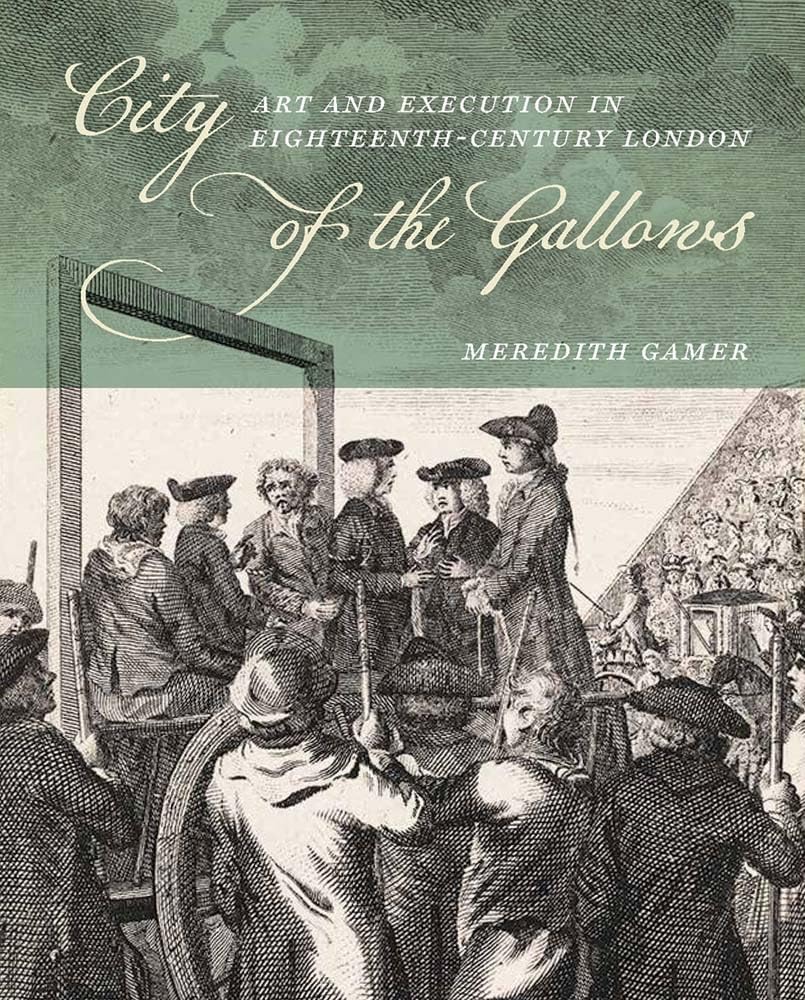
City of the Gallows
The macabre, interwoven histories of art and punishment in eighteenth-century London
Over the course of the eighteenth century, the visual arts in Britain flourished as never before. The nation's first art academies were founded; its first exhibitions of contemporary art were staged; and a vastly expanded public for the arts began to form. City of the Gallows argues that these developments were intimately linked to another, darker kind of art: the spectacle of capital punishment.
Between 1680 and 1820, the number of crimes punishable by death under British law rose exponentially—from roughly fifty to over two hundred. At Tyburn, London's main execution ground, dozens of people were hanged each year before thousands of spectators. In some cases, these brutal displays of state-sanctioned violence were extended through the infliction of additional penalties, such as gibbeting and dissection.
Across four chapters, this generously illustrated volume uncovers the complex and often unexpected connections that emerged between eighteenth-century London's sights and sites of punishment and its spaces of art making, instruction, and display. Drawing together a wide range of images, objects, and texts—from popular woodcuts and anatomical sculptures to philosophical essays and dictionaries of slang—it offers new readings of well-known works by William Hogarth, Johan Zoffany, and Joseph Wright of Derby, and coaxes meaning from others that would seem—at first glance—to resist or defy traditional modes of critical analysis.
In these ways, City of the Gallows seeks to challenge and expand the boundaries of art historical enquiry, both within the field of studies in British art, and beyond.
The macabre, interwoven histories of art and punishment in eighteenth-century London
Over the course of the eighteenth century, the visual arts in Britain flourished as never before. The nation's first art academies were founded; its first exhibitions of contemporary art were staged; and a vastly expanded public for the arts began to form. City of the Gallows argues that these developments were intimately linked to another, darker kind of art: the spectacle of capital punishment.
Between 1680 and 1820, the number of crimes punishable by death under British law rose exponentially—from roughly fifty to over two hundred. At Tyburn, London's main execution ground, dozens of people were hanged each year before thousands of spectators. In some cases, these brutal displays of state-sanctioned violence were extended through the infliction of additional penalties, such as gibbeting and dissection.
Across four chapters, this generously illustrated volume uncovers the complex and often unexpected connections that emerged between eighteenth-century London's sights and sites of punishment and its spaces of art making, instruction, and display. Drawing together a wide range of images, objects, and texts—from popular woodcuts and anatomical sculptures to philosophical essays and dictionaries of slang—it offers new readings of well-known works by William Hogarth, Johan Zoffany, and Joseph Wright of Derby, and coaxes meaning from others that would seem—at first glance—to resist or defy traditional modes of critical analysis.
In these ways, City of the Gallows seeks to challenge and expand the boundaries of art historical enquiry, both within the field of studies in British art, and beyond.
Original: $55.33
-65%$55.33
$19.37Description
The macabre, interwoven histories of art and punishment in eighteenth-century London
Over the course of the eighteenth century, the visual arts in Britain flourished as never before. The nation's first art academies were founded; its first exhibitions of contemporary art were staged; and a vastly expanded public for the arts began to form. City of the Gallows argues that these developments were intimately linked to another, darker kind of art: the spectacle of capital punishment.
Between 1680 and 1820, the number of crimes punishable by death under British law rose exponentially—from roughly fifty to over two hundred. At Tyburn, London's main execution ground, dozens of people were hanged each year before thousands of spectators. In some cases, these brutal displays of state-sanctioned violence were extended through the infliction of additional penalties, such as gibbeting and dissection.
Across four chapters, this generously illustrated volume uncovers the complex and often unexpected connections that emerged between eighteenth-century London's sights and sites of punishment and its spaces of art making, instruction, and display. Drawing together a wide range of images, objects, and texts—from popular woodcuts and anatomical sculptures to philosophical essays and dictionaries of slang—it offers new readings of well-known works by William Hogarth, Johan Zoffany, and Joseph Wright of Derby, and coaxes meaning from others that would seem—at first glance—to resist or defy traditional modes of critical analysis.
In these ways, City of the Gallows seeks to challenge and expand the boundaries of art historical enquiry, both within the field of studies in British art, and beyond.