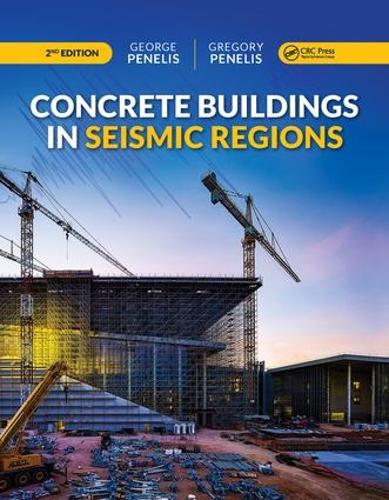
Concrete Buildings in Seismic Regions
Reinforced concrete (R/C) is one of the main building materials used worldwide, and understanding its structural performance under gravity and seismic loads, albeit complex, is crucial for the design of cost-effective and safe buildings.
Concrete Buildings in Seismic Regions comprehensively covers all the analysis and design issues related to the design of reinforced concrete buildings under seismic action. It serves as a valuable reference for structural engineers dealing with specific problems during the design process and is also suitable for undergraduate and graduate courses in structural, concrete, and earthquake engineering.
This revised edition provides new and significantly developed coverage of seismic isolation and passive devices, along with recent code modifications and notes on future standards developments. It retains an overview of structural dynamics, the analysis and design of new R/C buildings in seismic regions, post-earthquake damage evaluation, pre-earthquake assessment of buildings and retrofitting procedures, complete with several numerical examples.
The book outlines appropriate structural systems for various types of buildings, explores recent developments, and covers the last two decades of analysis, design, and earthquake engineering. It specifically addresses seismic demand issues and the basic aspects of structural dynamics, considering the "capacity" of structural systems to withstand seismic effects in terms of strength and deformation. Additionally, it highlights the assessment of existing R/C buildings under seismic action. All material has been developed to fit a modern seismic code, offering in-depth knowledge of the background upon which the code rules are based. The content complies with European Codes of Practice for R/C buildings in seismic regions and includes references to current American Standards for seismic design.
Reinforced concrete (R/C) is one of the main building materials used worldwide, and understanding its structural performance under gravity and seismic loads, albeit complex, is crucial for the design of cost-effective and safe buildings.
Concrete Buildings in Seismic Regions comprehensively covers all the analysis and design issues related to the design of reinforced concrete buildings under seismic action. It serves as a valuable reference for structural engineers dealing with specific problems during the design process and is also suitable for undergraduate and graduate courses in structural, concrete, and earthquake engineering.
This revised edition provides new and significantly developed coverage of seismic isolation and passive devices, along with recent code modifications and notes on future standards developments. It retains an overview of structural dynamics, the analysis and design of new R/C buildings in seismic regions, post-earthquake damage evaluation, pre-earthquake assessment of buildings and retrofitting procedures, complete with several numerical examples.
The book outlines appropriate structural systems for various types of buildings, explores recent developments, and covers the last two decades of analysis, design, and earthquake engineering. It specifically addresses seismic demand issues and the basic aspects of structural dynamics, considering the "capacity" of structural systems to withstand seismic effects in terms of strength and deformation. Additionally, it highlights the assessment of existing R/C buildings under seismic action. All material has been developed to fit a modern seismic code, offering in-depth knowledge of the background upon which the code rules are based. The content complies with European Codes of Practice for R/C buildings in seismic regions and includes references to current American Standards for seismic design.
Description
Reinforced concrete (R/C) is one of the main building materials used worldwide, and understanding its structural performance under gravity and seismic loads, albeit complex, is crucial for the design of cost-effective and safe buildings.
Concrete Buildings in Seismic Regions comprehensively covers all the analysis and design issues related to the design of reinforced concrete buildings under seismic action. It serves as a valuable reference for structural engineers dealing with specific problems during the design process and is also suitable for undergraduate and graduate courses in structural, concrete, and earthquake engineering.
This revised edition provides new and significantly developed coverage of seismic isolation and passive devices, along with recent code modifications and notes on future standards developments. It retains an overview of structural dynamics, the analysis and design of new R/C buildings in seismic regions, post-earthquake damage evaluation, pre-earthquake assessment of buildings and retrofitting procedures, complete with several numerical examples.
The book outlines appropriate structural systems for various types of buildings, explores recent developments, and covers the last two decades of analysis, design, and earthquake engineering. It specifically addresses seismic demand issues and the basic aspects of structural dynamics, considering the "capacity" of structural systems to withstand seismic effects in terms of strength and deformation. Additionally, it highlights the assessment of existing R/C buildings under seismic action. All material has been developed to fit a modern seismic code, offering in-depth knowledge of the background upon which the code rules are based. The content complies with European Codes of Practice for R/C buildings in seismic regions and includes references to current American Standards for seismic design.