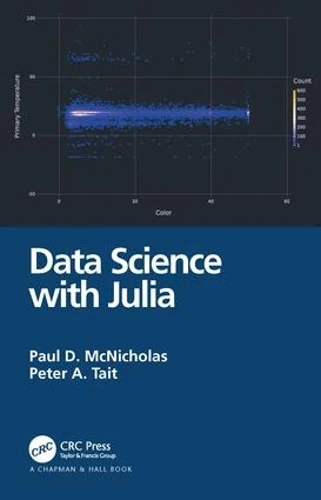
Data Science with Julia
Data Science with Julia is described as "a great way to both start learning data science through the promising Julia language and to become an efficient data scientist," according to Professor Charles Bouveyron, INRIA Chair in Data Science, Université Côte d’Azur, Nice, France.
Julia is an open-source programming language created to be as easy to use as languages like R and Python, while also achieving speeds comparable to C and Fortran. With its accessible, intuitive, and highly efficient base, Julia becomes a formidable language for data science. Using well-known data science methods that motivate the reader, Data Science with Julia helps readers get up to speed on key features of the Julia language, illustrating its facilities for data science and machine learning work.
Features:
- Covers the core components of Julia as well as packages relevant to the input, manipulation, and representation of data.
- Discusses several important topics in data science, including supervised and unsupervised learning.
- Reviews data visualisation using the Gadfly package, designed to emulate the popular ggplot2 package in R. Readers will learn how to create many common plots and visualise model results.
- Presents techniques to optimise Julia code for performance.
- Serves as an ideal resource for individuals knowledgeable in R wanting to learn Julia, although no previous knowledge of R or any programming language is required.
The advantages of Julia for data science cannot be understated. Beyond its speed and ease of use, there are over 1,900 packages available, and Julia can interface (either directly or through packages) with libraries written in R, Python, Matlab, C, C++, or Fortran. This book is suitable for senior undergraduates, beginner graduate students, or practising data scientists seeking to learn how to use Julia for data science.
"This book is a great way to both start learning data science through the promising Julia language and to become an efficient data scientist."
Professor Charles Bouveyron
INRIA Chair in Data Science
Université Côte d’Azur, Nice, France
Data Science with Julia is described as "a great way to both start learning data science through the promising Julia language and to become an efficient data scientist," according to Professor Charles Bouveyron, INRIA Chair in Data Science, Université Côte d’Azur, Nice, France.
Julia is an open-source programming language created to be as easy to use as languages like R and Python, while also achieving speeds comparable to C and Fortran. With its accessible, intuitive, and highly efficient base, Julia becomes a formidable language for data science. Using well-known data science methods that motivate the reader, Data Science with Julia helps readers get up to speed on key features of the Julia language, illustrating its facilities for data science and machine learning work.
Features:
- Covers the core components of Julia as well as packages relevant to the input, manipulation, and representation of data.
- Discusses several important topics in data science, including supervised and unsupervised learning.
- Reviews data visualisation using the Gadfly package, designed to emulate the popular ggplot2 package in R. Readers will learn how to create many common plots and visualise model results.
- Presents techniques to optimise Julia code for performance.
- Serves as an ideal resource for individuals knowledgeable in R wanting to learn Julia, although no previous knowledge of R or any programming language is required.
The advantages of Julia for data science cannot be understated. Beyond its speed and ease of use, there are over 1,900 packages available, and Julia can interface (either directly or through packages) with libraries written in R, Python, Matlab, C, C++, or Fortran. This book is suitable for senior undergraduates, beginner graduate students, or practising data scientists seeking to learn how to use Julia for data science.
"This book is a great way to both start learning data science through the promising Julia language and to become an efficient data scientist."
Professor Charles Bouveyron
INRIA Chair in Data Science
Université Côte d’Azur, Nice, France
Original: $77.24
-65%$77.24
$27.03Description
Data Science with Julia is described as "a great way to both start learning data science through the promising Julia language and to become an efficient data scientist," according to Professor Charles Bouveyron, INRIA Chair in Data Science, Université Côte d’Azur, Nice, France.
Julia is an open-source programming language created to be as easy to use as languages like R and Python, while also achieving speeds comparable to C and Fortran. With its accessible, intuitive, and highly efficient base, Julia becomes a formidable language for data science. Using well-known data science methods that motivate the reader, Data Science with Julia helps readers get up to speed on key features of the Julia language, illustrating its facilities for data science and machine learning work.
Features:
- Covers the core components of Julia as well as packages relevant to the input, manipulation, and representation of data.
- Discusses several important topics in data science, including supervised and unsupervised learning.
- Reviews data visualisation using the Gadfly package, designed to emulate the popular ggplot2 package in R. Readers will learn how to create many common plots and visualise model results.
- Presents techniques to optimise Julia code for performance.
- Serves as an ideal resource for individuals knowledgeable in R wanting to learn Julia, although no previous knowledge of R or any programming language is required.
The advantages of Julia for data science cannot be understated. Beyond its speed and ease of use, there are over 1,900 packages available, and Julia can interface (either directly or through packages) with libraries written in R, Python, Matlab, C, C++, or Fortran. This book is suitable for senior undergraduates, beginner graduate students, or practising data scientists seeking to learn how to use Julia for data science.
"This book is a great way to both start learning data science through the promising Julia language and to become an efficient data scientist."
Professor Charles Bouveyron
INRIA Chair in Data Science
Université Côte d’Azur, Nice, France