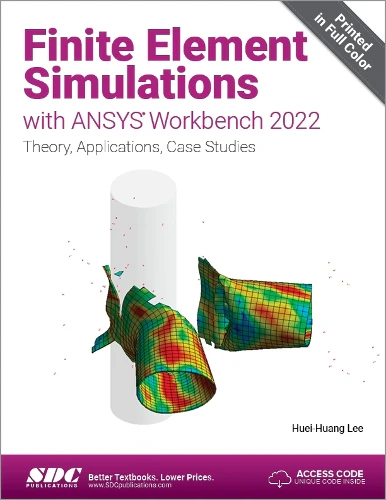
Finite Element Simulations with ANSYS Workbench 2022
Finite Element Simulations with ANSYS Workbench 2022 is a comprehensive and easy-to-understand workbook. Printed in full colour, it utilises rich graphics and step-by-step instructions to guide you through learning how to perform finite element simulations using ANSYS Workbench.
Twenty-seven real-world case studies are used throughout the book. Many of these case studies are industrial or research projects that you build from scratch. Prebuilt project files are available for download should you run into any problems. Companion videos, demonstrating exactly how to perform each tutorial, are also available.
Relevant background knowledge is reviewed whenever necessary. To be efficient, the review is conceptual rather than mathematical. Key concepts are inserted whenever appropriate and summarised at the end of each chapter. Additional exercises or extension research problems are provided as homework at the end of each chapter.
A learning approach emphasising hands-on experiences is utilised throughout the entire book. A typical chapter consists of six sections. The first two provide step-by-step examples. The third section attempts to complement the exercises by providing a more systematic view of the chapter subject. The following two sections offer more exercises, and the final section provides review problems.
Who this book is for
This book is designed to be used mainly as a textbook for undergraduate and graduate students. It will work well in:
- a finite element simulation course taken before any theory-intensive courses
- an auxiliary tool used as a tutorial in parallel during a Finite Element Methods course
- an advanced, application-oriented, course taken after a Finite Element Methods course
Finite Element Simulations with ANSYS Workbench 2022 is a comprehensive and easy-to-understand workbook. Printed in full colour, it utilises rich graphics and step-by-step instructions to guide you through learning how to perform finite element simulations using ANSYS Workbench.
Twenty-seven real-world case studies are used throughout the book. Many of these case studies are industrial or research projects that you build from scratch. Prebuilt project files are available for download should you run into any problems. Companion videos, demonstrating exactly how to perform each tutorial, are also available.
Relevant background knowledge is reviewed whenever necessary. To be efficient, the review is conceptual rather than mathematical. Key concepts are inserted whenever appropriate and summarised at the end of each chapter. Additional exercises or extension research problems are provided as homework at the end of each chapter.
A learning approach emphasising hands-on experiences is utilised throughout the entire book. A typical chapter consists of six sections. The first two provide step-by-step examples. The third section attempts to complement the exercises by providing a more systematic view of the chapter subject. The following two sections offer more exercises, and the final section provides review problems.
Who this book is for
This book is designed to be used mainly as a textbook for undergraduate and graduate students. It will work well in:
- a finite element simulation course taken before any theory-intensive courses
- an auxiliary tool used as a tutorial in parallel during a Finite Element Methods course
- an advanced, application-oriented, course taken after a Finite Element Methods course
Description
Finite Element Simulations with ANSYS Workbench 2022 is a comprehensive and easy-to-understand workbook. Printed in full colour, it utilises rich graphics and step-by-step instructions to guide you through learning how to perform finite element simulations using ANSYS Workbench.
Twenty-seven real-world case studies are used throughout the book. Many of these case studies are industrial or research projects that you build from scratch. Prebuilt project files are available for download should you run into any problems. Companion videos, demonstrating exactly how to perform each tutorial, are also available.
Relevant background knowledge is reviewed whenever necessary. To be efficient, the review is conceptual rather than mathematical. Key concepts are inserted whenever appropriate and summarised at the end of each chapter. Additional exercises or extension research problems are provided as homework at the end of each chapter.
A learning approach emphasising hands-on experiences is utilised throughout the entire book. A typical chapter consists of six sections. The first two provide step-by-step examples. The third section attempts to complement the exercises by providing a more systematic view of the chapter subject. The following two sections offer more exercises, and the final section provides review problems.
Who this book is for
This book is designed to be used mainly as a textbook for undergraduate and graduate students. It will work well in:
- a finite element simulation course taken before any theory-intensive courses
- an auxiliary tool used as a tutorial in parallel during a Finite Element Methods course
- an advanced, application-oriented, course taken after a Finite Element Methods course