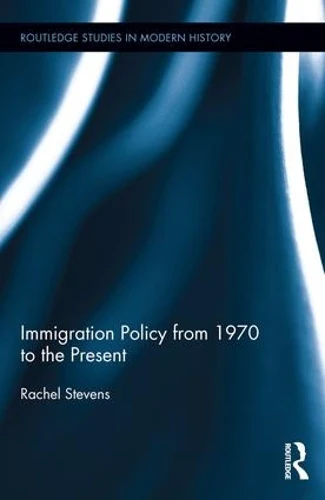
Immigration Policy from 1970 to the Present
This book examines national debates on immigration, asylum seekers, and guest worker programmes from 1970 to the present. Over the past 45 years, contemporary immigration has had a profound impact throughout North America, Europe, and Australasia, yet the admission of ethnically diverse immigrants was far from inevitable. In the midst of significant social change, policymakers grappled with fundamental questions: what is the purpose of immigration in an age of mass mobility? Which immigrants should be selected and potentially become citizens and who should be excluded? How should immigration be controlled in an era of universal human rights and non-discrimination?
Immigration Policy from 1970 to the Present provides an in-depth case study comparison of two settler societies, Australia and the United States, while drawing parallels with Europe, Canada, and New Zealand. Though contemporary immigration history that focuses on one national setting is well established, this book is unique because it actively compares how a number of societies debated vexing immigration policy challenges. The book also explores the ideas, values, and principles that underpin this contentious area of public policy, and in doing so, permits a broader understanding of contemporary immigration than outlining policies alone.
This book examines national debates on immigration, asylum seekers, and guest worker programmes from 1970 to the present. Over the past 45 years, contemporary immigration has had a profound impact throughout North America, Europe, and Australasia, yet the admission of ethnically diverse immigrants was far from inevitable. In the midst of significant social change, policymakers grappled with fundamental questions: what is the purpose of immigration in an age of mass mobility? Which immigrants should be selected and potentially become citizens and who should be excluded? How should immigration be controlled in an era of universal human rights and non-discrimination?
Immigration Policy from 1970 to the Present provides an in-depth case study comparison of two settler societies, Australia and the United States, while drawing parallels with Europe, Canada, and New Zealand. Though contemporary immigration history that focuses on one national setting is well established, this book is unique because it actively compares how a number of societies debated vexing immigration policy challenges. The book also explores the ideas, values, and principles that underpin this contentious area of public policy, and in doing so, permits a broader understanding of contemporary immigration than outlining policies alone.
Description
This book examines national debates on immigration, asylum seekers, and guest worker programmes from 1970 to the present. Over the past 45 years, contemporary immigration has had a profound impact throughout North America, Europe, and Australasia, yet the admission of ethnically diverse immigrants was far from inevitable. In the midst of significant social change, policymakers grappled with fundamental questions: what is the purpose of immigration in an age of mass mobility? Which immigrants should be selected and potentially become citizens and who should be excluded? How should immigration be controlled in an era of universal human rights and non-discrimination?
Immigration Policy from 1970 to the Present provides an in-depth case study comparison of two settler societies, Australia and the United States, while drawing parallels with Europe, Canada, and New Zealand. Though contemporary immigration history that focuses on one national setting is well established, this book is unique because it actively compares how a number of societies debated vexing immigration policy challenges. The book also explores the ideas, values, and principles that underpin this contentious area of public policy, and in doing so, permits a broader understanding of contemporary immigration than outlining policies alone.