Intelligent Autonomy of UAVs
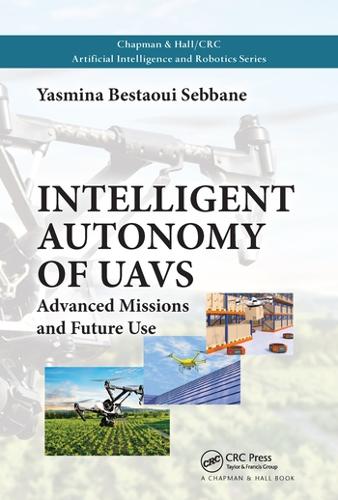
Intelligent Autonomy of UAVs: Advanced Missions and Future Use provides an approach to the formulation of the fundamental task typical to any mission and offers guidelines on how this task can be solved by different generic robotic problems. As such, this book aims to provide a systems engineering perspective to UAV projects, uncovering the real issues that need to be resolved irrespective of the application.
Following an introduction to the rapidly evolving field of aerial robotics, the book presents topics such as autonomy, mission analysis, human-UAV teams, and both homogeneous and heterogeneous UAV teams. Furthermore, it explores UAV-UGV teams and covers generic robotic problems such as orienteering and coverage. The book then introduces deployment, patrolling, and foraging, while the final section addresses a crucial application: aerial search, tracking, and surveillance.
This book is designed for both scientists and practitioners. For practitioners, it presents existing solutions that are categorised according to various missions, including surveillance and reconnaissance, 3D mapping, urban monitoring, precision agriculture, forestry, disaster assessment and monitoring, security, and industrial plant inspection.
For scientists, it provides an overview of generic robotic problems such as coverage and orienteering; deployment, patrolling and foraging; search, tracking, and surveillance. The design and analysis of algorithms pose a unique combination of questions from multiple fields, including robotics, operational research, control theory, and computer science.
Intelligent Autonomy of UAVs: Advanced Missions and Future Use provides an approach to the formulation of the fundamental task typical to any mission and offers guidelines on how this task can be solved by different generic robotic problems. As such, this book aims to provide a systems engineering perspective to UAV projects, uncovering the real issues that need to be resolved irrespective of the application.
Following an introduction to the rapidly evolving field of aerial robotics, the book presents topics such as autonomy, mission analysis, human-UAV teams, and both homogeneous and heterogeneous UAV teams. Furthermore, it explores UAV-UGV teams and covers generic robotic problems such as orienteering and coverage. The book then introduces deployment, patrolling, and foraging, while the final section addresses a crucial application: aerial search, tracking, and surveillance.
This book is designed for both scientists and practitioners. For practitioners, it presents existing solutions that are categorised according to various missions, including surveillance and reconnaissance, 3D mapping, urban monitoring, precision agriculture, forestry, disaster assessment and monitoring, security, and industrial plant inspection.
For scientists, it provides an overview of generic robotic problems such as coverage and orienteering; deployment, patrolling and foraging; search, tracking, and surveillance. The design and analysis of algorithms pose a unique combination of questions from multiple fields, including robotics, operational research, control theory, and computer science.
Description
Intelligent Autonomy of UAVs: Advanced Missions and Future Use provides an approach to the formulation of the fundamental task typical to any mission and offers guidelines on how this task can be solved by different generic robotic problems. As such, this book aims to provide a systems engineering perspective to UAV projects, uncovering the real issues that need to be resolved irrespective of the application.
Following an introduction to the rapidly evolving field of aerial robotics, the book presents topics such as autonomy, mission analysis, human-UAV teams, and both homogeneous and heterogeneous UAV teams. Furthermore, it explores UAV-UGV teams and covers generic robotic problems such as orienteering and coverage. The book then introduces deployment, patrolling, and foraging, while the final section addresses a crucial application: aerial search, tracking, and surveillance.
This book is designed for both scientists and practitioners. For practitioners, it presents existing solutions that are categorised according to various missions, including surveillance and reconnaissance, 3D mapping, urban monitoring, precision agriculture, forestry, disaster assessment and monitoring, security, and industrial plant inspection.
For scientists, it provides an overview of generic robotic problems such as coverage and orienteering; deployment, patrolling and foraging; search, tracking, and surveillance. The design and analysis of algorithms pose a unique combination of questions from multiple fields, including robotics, operational research, control theory, and computer science.