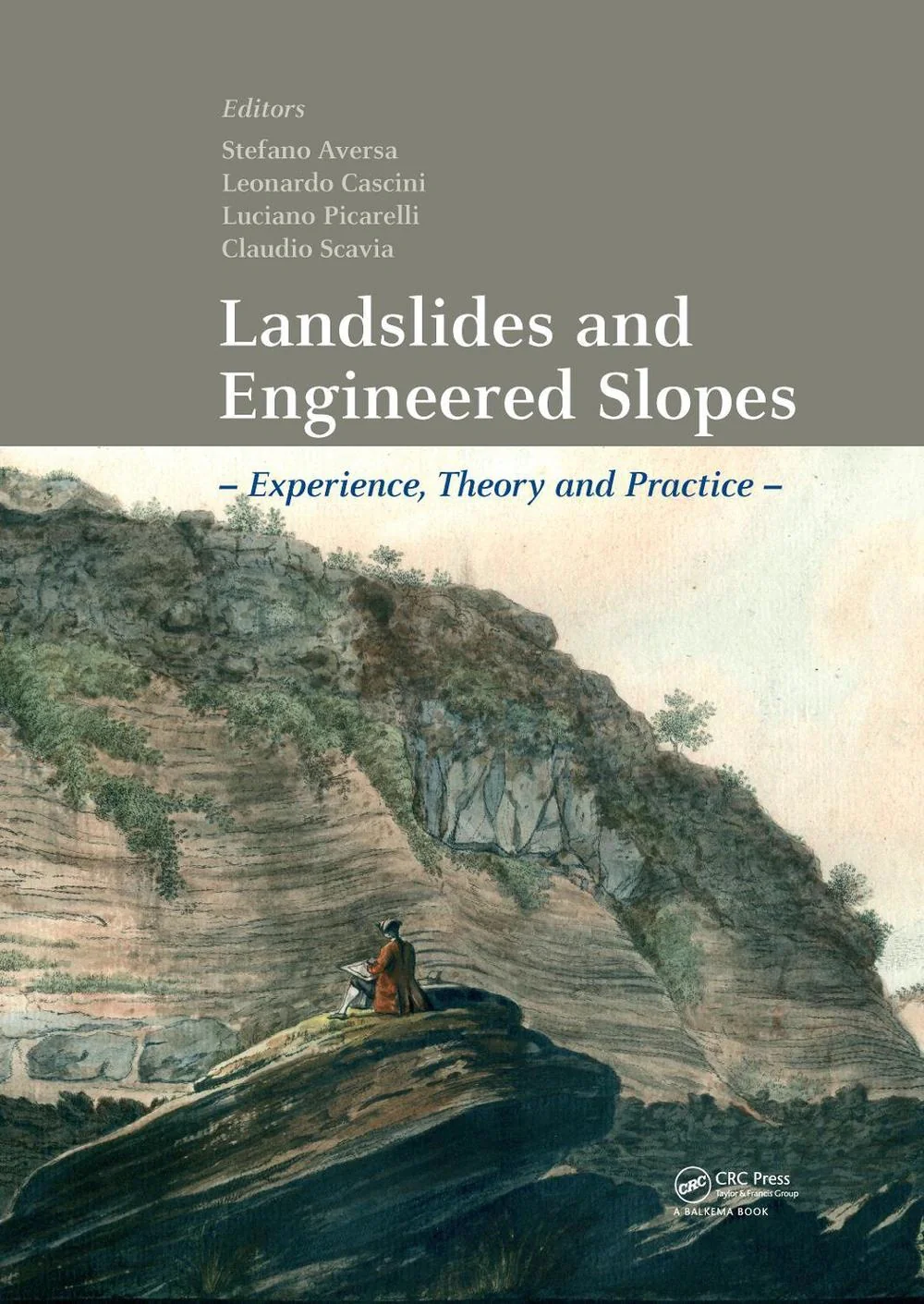
Landslides and Engineered Slopes. Experience, Theory and Practice
Landslides and Engineered Slopes. Experience, Theory and Practice contains the invited lectures and all papers presented at the 12th International Symposium on Landslides, held in Naples, Italy, from 12-19 June 2016. The book aims to emphasise the relationship between landslides and other natural hazards. Hence, three of the main sessions focus on volcanic-induced landslides, earthquake-induced landslides, and weather-induced landslides respectively, while the fourth main session deals with human-induced landslides. Some papers presented in a special session devoted to "Subaerial and submarine landslide processes and hazard" and in a "Young Session" complete the book.
Landslides and Engineered Slopes. Experience, Theory and Practice underlines the importance of the classic approach of modern science, which moves from experience to theory, as the basic instrument to study landslides. Experience is the key to understanding the natural phenomena, focusing on all the factors that play a major role. Theory is the instrument to manage the data provided by experience following a mathematical approach; this allows not only to clarify the nature and the deep causes of phenomena but mostly, to predict future events and, if required, manage similar occurrences. Practical benefits arise from the results of theory to protect people and man-made works.
Landslides and Engineered Slopes. Experience, Theory and Practice is useful to scientists and practitioners working in the areas of rock and soil mechanics, geotechnical engineering, engineering geology, and geology.
Landslides and Engineered Slopes. Experience, Theory and Practice contains the invited lectures and all papers presented at the 12th International Symposium on Landslides, held in Naples, Italy, from 12-19 June 2016. The book aims to emphasise the relationship between landslides and other natural hazards. Hence, three of the main sessions focus on volcanic-induced landslides, earthquake-induced landslides, and weather-induced landslides respectively, while the fourth main session deals with human-induced landslides. Some papers presented in a special session devoted to "Subaerial and submarine landslide processes and hazard" and in a "Young Session" complete the book.
Landslides and Engineered Slopes. Experience, Theory and Practice underlines the importance of the classic approach of modern science, which moves from experience to theory, as the basic instrument to study landslides. Experience is the key to understanding the natural phenomena, focusing on all the factors that play a major role. Theory is the instrument to manage the data provided by experience following a mathematical approach; this allows not only to clarify the nature and the deep causes of phenomena but mostly, to predict future events and, if required, manage similar occurrences. Practical benefits arise from the results of theory to protect people and man-made works.
Landslides and Engineered Slopes. Experience, Theory and Practice is useful to scientists and practitioners working in the areas of rock and soil mechanics, geotechnical engineering, engineering geology, and geology.
Original: $474.39
-65%$474.39
$166.04Description
Landslides and Engineered Slopes. Experience, Theory and Practice contains the invited lectures and all papers presented at the 12th International Symposium on Landslides, held in Naples, Italy, from 12-19 June 2016. The book aims to emphasise the relationship between landslides and other natural hazards. Hence, three of the main sessions focus on volcanic-induced landslides, earthquake-induced landslides, and weather-induced landslides respectively, while the fourth main session deals with human-induced landslides. Some papers presented in a special session devoted to "Subaerial and submarine landslide processes and hazard" and in a "Young Session" complete the book.
Landslides and Engineered Slopes. Experience, Theory and Practice underlines the importance of the classic approach of modern science, which moves from experience to theory, as the basic instrument to study landslides. Experience is the key to understanding the natural phenomena, focusing on all the factors that play a major role. Theory is the instrument to manage the data provided by experience following a mathematical approach; this allows not only to clarify the nature and the deep causes of phenomena but mostly, to predict future events and, if required, manage similar occurrences. Practical benefits arise from the results of theory to protect people and man-made works.
Landslides and Engineered Slopes. Experience, Theory and Practice is useful to scientists and practitioners working in the areas of rock and soil mechanics, geotechnical engineering, engineering geology, and geology.