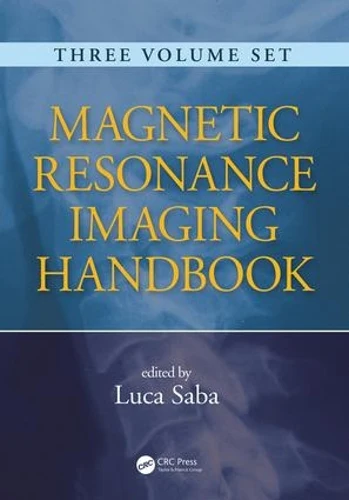
Magnetic Resonance Imaging Handbook
Magnetic resonance imaging (MRI) is a technique used in biomedical imaging and radiology to visualise internal structures of the body. Because MRI provides excellent contrast between different soft tissues, the technique is especially useful for diagnostic imaging of the brain, muscles, and heart.
In the past 20 years, MRI technology has improved significantly with the introduction of systems up to 7 Tesla (7 T) and with the development of numerous post-processing algorithms such as diffusion tensor imaging (DTI), functional MRI (fMRI), and spectroscopic imaging. From these developments, the diagnostic potentialities of MRI have improved impressively with an exceptional spatial resolution and the possibility of analysing the morphology and function of several kinds of pathology.
Given these exciting developments, the Magnetic Resonance Imaging Handbook is a timely addition to the growing body of literature in the field. Comprised of three volumes, this comprehensive handbook:
- Covers the technology and practice of MRI from physical principles to cutting-edge applications
- Discusses MRI of the neck, brain, cardiovascular system, thorax, abdomen, pelvis, and musculoskeletal system
- Highlights each organ’s anatomy and pathological processes with high-quality images
- Examines the protocols and potentialities of advanced MRI scanners such as 7 T systems
- Includes extensive references at the end of each chapter to enhance further study
Thus, the Magnetic Resonance Imaging Handbook provides radiologists and imaging specialists with a valuable, state-of-the-art reference on MRI.
Magnetic resonance imaging (MRI) is a technique used in biomedical imaging and radiology to visualise internal structures of the body. Because MRI provides excellent contrast between different soft tissues, the technique is especially useful for diagnostic imaging of the brain, muscles, and heart.
In the past 20 years, MRI technology has improved significantly with the introduction of systems up to 7 Tesla (7 T) and with the development of numerous post-processing algorithms such as diffusion tensor imaging (DTI), functional MRI (fMRI), and spectroscopic imaging. From these developments, the diagnostic potentialities of MRI have improved impressively with an exceptional spatial resolution and the possibility of analysing the morphology and function of several kinds of pathology.
Given these exciting developments, the Magnetic Resonance Imaging Handbook is a timely addition to the growing body of literature in the field. Comprised of three volumes, this comprehensive handbook:
- Covers the technology and practice of MRI from physical principles to cutting-edge applications
- Discusses MRI of the neck, brain, cardiovascular system, thorax, abdomen, pelvis, and musculoskeletal system
- Highlights each organ’s anatomy and pathological processes with high-quality images
- Examines the protocols and potentialities of advanced MRI scanners such as 7 T systems
- Includes extensive references at the end of each chapter to enhance further study
Thus, the Magnetic Resonance Imaging Handbook provides radiologists and imaging specialists with a valuable, state-of-the-art reference on MRI.
Description
Magnetic resonance imaging (MRI) is a technique used in biomedical imaging and radiology to visualise internal structures of the body. Because MRI provides excellent contrast between different soft tissues, the technique is especially useful for diagnostic imaging of the brain, muscles, and heart.
In the past 20 years, MRI technology has improved significantly with the introduction of systems up to 7 Tesla (7 T) and with the development of numerous post-processing algorithms such as diffusion tensor imaging (DTI), functional MRI (fMRI), and spectroscopic imaging. From these developments, the diagnostic potentialities of MRI have improved impressively with an exceptional spatial resolution and the possibility of analysing the morphology and function of several kinds of pathology.
Given these exciting developments, the Magnetic Resonance Imaging Handbook is a timely addition to the growing body of literature in the field. Comprised of three volumes, this comprehensive handbook:
- Covers the technology and practice of MRI from physical principles to cutting-edge applications
- Discusses MRI of the neck, brain, cardiovascular system, thorax, abdomen, pelvis, and musculoskeletal system
- Highlights each organ’s anatomy and pathological processes with high-quality images
- Examines the protocols and potentialities of advanced MRI scanners such as 7 T systems
- Includes extensive references at the end of each chapter to enhance further study
Thus, the Magnetic Resonance Imaging Handbook provides radiologists and imaging specialists with a valuable, state-of-the-art reference on MRI.