Markets
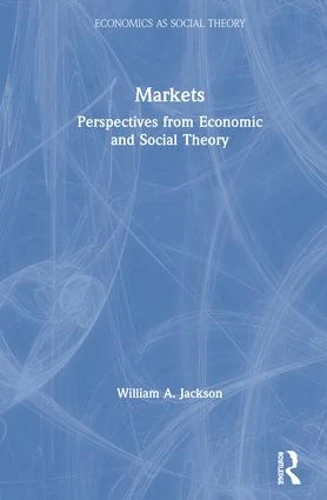
Defining markets has never been an easy task. Despite their importance for economic theory and practice, they are hard to pin down as a concept, and economists have tended to adopt simplified axiomatic models or rely on piecemeal case studies. Markets argues that an extended range of theory, social as well as economic, can provide a better foundation for the portrayal of markets.
The book first looks at the definition of markets, their inadequate treatment in orthodox economic theory, and their historical background in the pre-capitalist and capitalist eras. It then assesses various alternatives to orthodox theory, categorised as social/cultural, structural, functional and ethical approaches. Among the alternatives considered are institutionalist accounts, Marxian views, network models, performativity arguments, field theories, Austrian views and ethical notions of fair trade.
A key finding of the book is that these diverse approaches, valuable as they are, could present a more effective challenge to orthodoxy if they were less disparate. Possibilities are investigated for a more unified theoretical alternative to orthodoxy.
Unlike most studies of markets, this book adopts a fully interdisciplinary viewpoint expressed in accessible, non-technical language. Ideas are brought together from heterodox economics, social theory, critical realism, as well as other social sciences such as sociology, anthropology and geography.
Anybody seeking a broad critical survey of the theoretical analysis of markets will find this book useful, and it will be of great interest to economists, social scientists, students and policy-makers.
Defining markets has never been an easy task. Despite their importance for economic theory and practice, they are hard to pin down as a concept, and economists have tended to adopt simplified axiomatic models or rely on piecemeal case studies. Markets argues that an extended range of theory, social as well as economic, can provide a better foundation for the portrayal of markets.
The book first looks at the definition of markets, their inadequate treatment in orthodox economic theory, and their historical background in the pre-capitalist and capitalist eras. It then assesses various alternatives to orthodox theory, categorised as social/cultural, structural, functional and ethical approaches. Among the alternatives considered are institutionalist accounts, Marxian views, network models, performativity arguments, field theories, Austrian views and ethical notions of fair trade.
A key finding of the book is that these diverse approaches, valuable as they are, could present a more effective challenge to orthodoxy if they were less disparate. Possibilities are investigated for a more unified theoretical alternative to orthodoxy.
Unlike most studies of markets, this book adopts a fully interdisciplinary viewpoint expressed in accessible, non-technical language. Ideas are brought together from heterodox economics, social theory, critical realism, as well as other social sciences such as sociology, anthropology and geography.
Anybody seeking a broad critical survey of the theoretical analysis of markets will find this book useful, and it will be of great interest to economists, social scientists, students and policy-makers.
Description
Defining markets has never been an easy task. Despite their importance for economic theory and practice, they are hard to pin down as a concept, and economists have tended to adopt simplified axiomatic models or rely on piecemeal case studies. Markets argues that an extended range of theory, social as well as economic, can provide a better foundation for the portrayal of markets.
The book first looks at the definition of markets, their inadequate treatment in orthodox economic theory, and their historical background in the pre-capitalist and capitalist eras. It then assesses various alternatives to orthodox theory, categorised as social/cultural, structural, functional and ethical approaches. Among the alternatives considered are institutionalist accounts, Marxian views, network models, performativity arguments, field theories, Austrian views and ethical notions of fair trade.
A key finding of the book is that these diverse approaches, valuable as they are, could present a more effective challenge to orthodoxy if they were less disparate. Possibilities are investigated for a more unified theoretical alternative to orthodoxy.
Unlike most studies of markets, this book adopts a fully interdisciplinary viewpoint expressed in accessible, non-technical language. Ideas are brought together from heterodox economics, social theory, critical realism, as well as other social sciences such as sociology, anthropology and geography.
Anybody seeking a broad critical survey of the theoretical analysis of markets will find this book useful, and it will be of great interest to economists, social scientists, students and policy-makers.