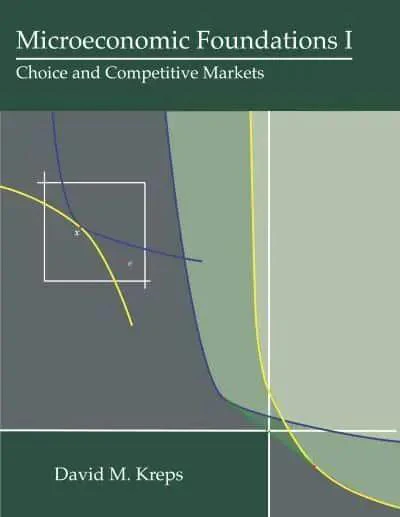
Microeconomic Foundations I
Microeconomic Foundations I develops the choice, price, and general equilibrium theory topics typically found in first-year theory sequences, but in deeper and more complete mathematical form than most standard texts provide. The objective is to take the reader from acquaintance with these foundational topics to something closer to mastery of the models and results connected to them.
Provides a rigorous treatment of some of the basic tools of economic modelling and reasoning, along with an assessment of the strengths and weaknesses of these tools. Complements standard texts and covers:
- Choice, preference, and utility
- Structural properties of preferences and utility functions
- Basics of consumer demand
- Revealed preference and Afriat's Theorem
- Choice under uncertainty
- Dynamic choice
- Social choice and efficiency
- Competitive and profit-maximising firms
- Expenditure minimisation
- Demand theory (duality methods)
- Producer and consumer surplus
- Aggregation
- General equilibrium
- Efficiency and the core
- GET, time, and uncertainty
- Other topics
Features a free web-based student's guide, which gives solutions to approximately half the problems, and a limited-access instructor's manual, which provides solutions to the rest of the problems. Contains appendixes that review most of the specific mathematics employed in the book, including a from-first-principles treatment of dynamic programming.
Microeconomic Foundations I develops the choice, price, and general equilibrium theory topics typically found in first-year theory sequences, but in deeper and more complete mathematical form than most standard texts provide. The objective is to take the reader from acquaintance with these foundational topics to something closer to mastery of the models and results connected to them.
Provides a rigorous treatment of some of the basic tools of economic modelling and reasoning, along with an assessment of the strengths and weaknesses of these tools. Complements standard texts and covers:
- Choice, preference, and utility
- Structural properties of preferences and utility functions
- Basics of consumer demand
- Revealed preference and Afriat's Theorem
- Choice under uncertainty
- Dynamic choice
- Social choice and efficiency
- Competitive and profit-maximising firms
- Expenditure minimisation
- Demand theory (duality methods)
- Producer and consumer surplus
- Aggregation
- General equilibrium
- Efficiency and the core
- GET, time, and uncertainty
- Other topics
Features a free web-based student's guide, which gives solutions to approximately half the problems, and a limited-access instructor's manual, which provides solutions to the rest of the problems. Contains appendixes that review most of the specific mathematics employed in the book, including a from-first-principles treatment of dynamic programming.
Original: $62.83
-65%$62.83
$21.99Description
Microeconomic Foundations I develops the choice, price, and general equilibrium theory topics typically found in first-year theory sequences, but in deeper and more complete mathematical form than most standard texts provide. The objective is to take the reader from acquaintance with these foundational topics to something closer to mastery of the models and results connected to them.
Provides a rigorous treatment of some of the basic tools of economic modelling and reasoning, along with an assessment of the strengths and weaknesses of these tools. Complements standard texts and covers:
- Choice, preference, and utility
- Structural properties of preferences and utility functions
- Basics of consumer demand
- Revealed preference and Afriat's Theorem
- Choice under uncertainty
- Dynamic choice
- Social choice and efficiency
- Competitive and profit-maximising firms
- Expenditure minimisation
- Demand theory (duality methods)
- Producer and consumer surplus
- Aggregation
- General equilibrium
- Efficiency and the core
- GET, time, and uncertainty
- Other topics
Features a free web-based student's guide, which gives solutions to approximately half the problems, and a limited-access instructor's manual, which provides solutions to the rest of the problems. Contains appendixes that review most of the specific mathematics employed in the book, including a from-first-principles treatment of dynamic programming.