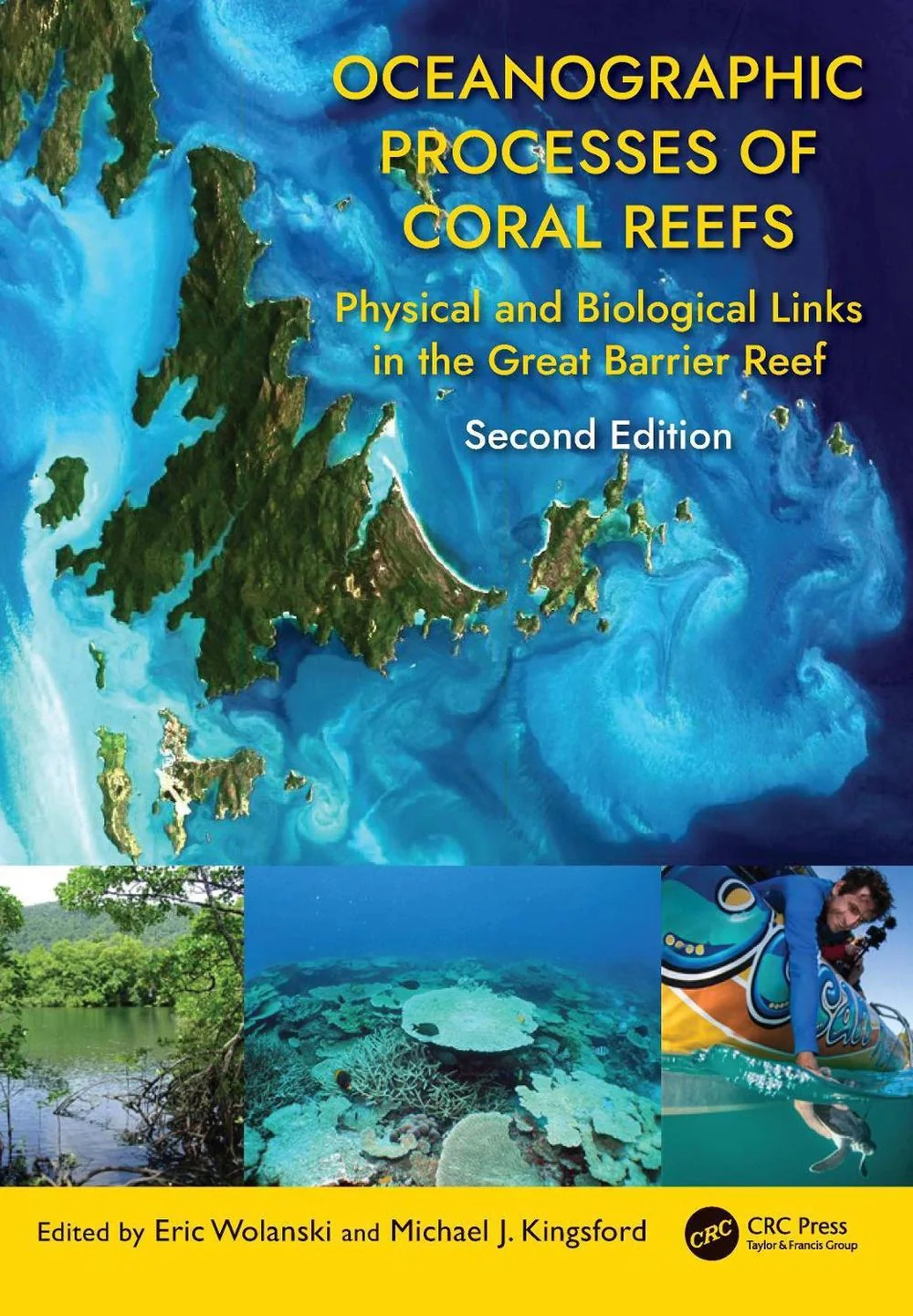
Oceanographic Processes of Coral Reefs
In the last two decades since publication of the first edition, substantial advancements have been made in the science, the need for transdisciplinary approaches to coral reef protection greater than ever before. This new edition, now in full colour throughout with accompanying animations, goes beyond identifying foundational information and current problems to pinpoint science-based solutions for managers, stakeholders and policy makers.
Coral reefs are connected by currents that carry plankton and the larvae of many reef-based organisms. Further, they supply food to reefs. Currents also bring pollutants from the land and, together with the atmosphere, affect the surrounding ocean. The chapters in Oceanographic Processes of Coral Reefs provide a much-needed review of the biophysics of reefs with an emphasis on the Great Barrier Reef as an ecosystem. The focus is on interactions between currents, waves, sediment, and the dynamics of coastal and reef-based ecosystems. The topographic complexity of reefs redirects mainstream currents, creates tidal eddies, mushroom jets, boundary layers, and stagnation zones, and this turbulence is enhanced by the oceanographic chaos in the adjoining Coral Sea. This is the environment in which particles and organisms of a range of sizes live, from tiny plankton to megafauna. This generates faunal connectivity at scales of metres to thousands of kilometres within the Great Barrier Reef and with the adjoining ocean.
Pollution from land-use is increasing and remedial measures are described both on land and on coral cays. The impact of climate change is quantified in case studies about mangroves and corals. Modelling this biophysical complexity is increasing in sophistication, and the authors suggest how the field can advance further.
In the last two decades since publication of the first edition, substantial advancements have been made in the science, the need for transdisciplinary approaches to coral reef protection greater than ever before. This new edition, now in full colour throughout with accompanying animations, goes beyond identifying foundational information and current problems to pinpoint science-based solutions for managers, stakeholders and policy makers.
Coral reefs are connected by currents that carry plankton and the larvae of many reef-based organisms. Further, they supply food to reefs. Currents also bring pollutants from the land and, together with the atmosphere, affect the surrounding ocean. The chapters in Oceanographic Processes of Coral Reefs provide a much-needed review of the biophysics of reefs with an emphasis on the Great Barrier Reef as an ecosystem. The focus is on interactions between currents, waves, sediment, and the dynamics of coastal and reef-based ecosystems. The topographic complexity of reefs redirects mainstream currents, creates tidal eddies, mushroom jets, boundary layers, and stagnation zones, and this turbulence is enhanced by the oceanographic chaos in the adjoining Coral Sea. This is the environment in which particles and organisms of a range of sizes live, from tiny plankton to megafauna. This generates faunal connectivity at scales of metres to thousands of kilometres within the Great Barrier Reef and with the adjoining ocean.
Pollution from land-use is increasing and remedial measures are described both on land and on coral cays. The impact of climate change is quantified in case studies about mangroves and corals. Modelling this biophysical complexity is increasing in sophistication, and the authors suggest how the field can advance further.
Original: $352.19
-65%$352.19
$123.27Description
In the last two decades since publication of the first edition, substantial advancements have been made in the science, the need for transdisciplinary approaches to coral reef protection greater than ever before. This new edition, now in full colour throughout with accompanying animations, goes beyond identifying foundational information and current problems to pinpoint science-based solutions for managers, stakeholders and policy makers.
Coral reefs are connected by currents that carry plankton and the larvae of many reef-based organisms. Further, they supply food to reefs. Currents also bring pollutants from the land and, together with the atmosphere, affect the surrounding ocean. The chapters in Oceanographic Processes of Coral Reefs provide a much-needed review of the biophysics of reefs with an emphasis on the Great Barrier Reef as an ecosystem. The focus is on interactions between currents, waves, sediment, and the dynamics of coastal and reef-based ecosystems. The topographic complexity of reefs redirects mainstream currents, creates tidal eddies, mushroom jets, boundary layers, and stagnation zones, and this turbulence is enhanced by the oceanographic chaos in the adjoining Coral Sea. This is the environment in which particles and organisms of a range of sizes live, from tiny plankton to megafauna. This generates faunal connectivity at scales of metres to thousands of kilometres within the Great Barrier Reef and with the adjoining ocean.
Pollution from land-use is increasing and remedial measures are described both on land and on coral cays. The impact of climate change is quantified in case studies about mangroves and corals. Modelling this biophysical complexity is increasing in sophistication, and the authors suggest how the field can advance further.