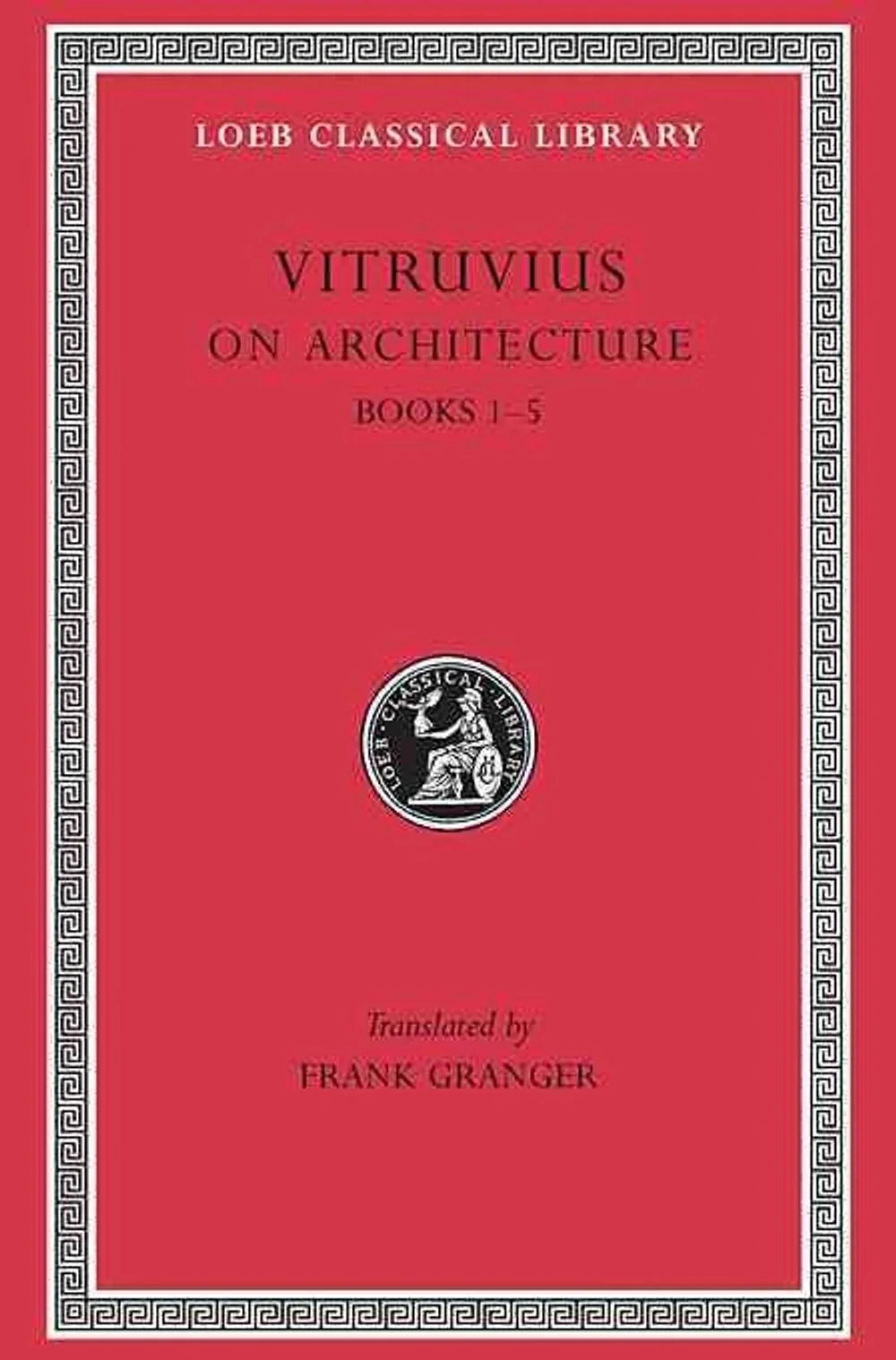
On Architecture, Volume I
Vitruvius (Marcus V. Pollio), a Roman architect and engineer, studied Greek philosophy and science and gained experience throughout his professional career. He was one of those appointed to oversee imperial artillery or military engines and was the architect of at least one building unit for Augustus during the reconstruction of Rome.
Late in life and in ill health, he completed his work on De Architectura sometime before 27 BCE. After its rediscovery in the fifteenth century, this work was influential enough to be studied by architects from the early Renaissance to recent times.
In On Architecture, Vitruvius adds his own experiences to the tradition of Greek theory and practice. This treatise, composed of ten books, covers a range of topics:
Book 1: Requirements for an architect; town planning; design, cities, aspects; temples.
Book 2: Materials and their treatment. Greek systems.
Book 3: Styles. Forms of Greek temples. Ionic.
Book 4: Styles. Corinthian, Ionic, Doric; Tuscan; altars.
Book 5: Other public buildings (fora, basilicae, theatres, colonnades, baths, harbours).
Book 6: Sites and planning, especially of houses.
Book 7: Construction of pavements, roads, mosaic floors, vaults. Decoration (stucco, wall painting, colours).
Book 8: Hydraulic engineering; water supply; aqueducts.
Book 9: Astronomy. Greek and Roman discoveries; signs of the zodiac, planets, moon phases, constellations, astrology, gnomon, sundials.
Book 10: Machines for war and other purposes.
Vitruvius (Marcus V. Pollio), a Roman architect and engineer, studied Greek philosophy and science and gained experience throughout his professional career. He was one of those appointed to oversee imperial artillery or military engines and was the architect of at least one building unit for Augustus during the reconstruction of Rome.
Late in life and in ill health, he completed his work on De Architectura sometime before 27 BCE. After its rediscovery in the fifteenth century, this work was influential enough to be studied by architects from the early Renaissance to recent times.
In On Architecture, Vitruvius adds his own experiences to the tradition of Greek theory and practice. This treatise, composed of ten books, covers a range of topics:
Book 1: Requirements for an architect; town planning; design, cities, aspects; temples.
Book 2: Materials and their treatment. Greek systems.
Book 3: Styles. Forms of Greek temples. Ionic.
Book 4: Styles. Corinthian, Ionic, Doric; Tuscan; altars.
Book 5: Other public buildings (fora, basilicae, theatres, colonnades, baths, harbours).
Book 6: Sites and planning, especially of houses.
Book 7: Construction of pavements, roads, mosaic floors, vaults. Decoration (stucco, wall painting, colours).
Book 8: Hydraulic engineering; water supply; aqueducts.
Book 9: Astronomy. Greek and Roman discoveries; signs of the zodiac, planets, moon phases, constellations, astrology, gnomon, sundials.
Book 10: Machines for war and other purposes.
Original: $53.03
-65%$53.03
$18.56Description
Vitruvius (Marcus V. Pollio), a Roman architect and engineer, studied Greek philosophy and science and gained experience throughout his professional career. He was one of those appointed to oversee imperial artillery or military engines and was the architect of at least one building unit for Augustus during the reconstruction of Rome.
Late in life and in ill health, he completed his work on De Architectura sometime before 27 BCE. After its rediscovery in the fifteenth century, this work was influential enough to be studied by architects from the early Renaissance to recent times.
In On Architecture, Vitruvius adds his own experiences to the tradition of Greek theory and practice. This treatise, composed of ten books, covers a range of topics:
Book 1: Requirements for an architect; town planning; design, cities, aspects; temples.
Book 2: Materials and their treatment. Greek systems.
Book 3: Styles. Forms of Greek temples. Ionic.
Book 4: Styles. Corinthian, Ionic, Doric; Tuscan; altars.
Book 5: Other public buildings (fora, basilicae, theatres, colonnades, baths, harbours).
Book 6: Sites and planning, especially of houses.
Book 7: Construction of pavements, roads, mosaic floors, vaults. Decoration (stucco, wall painting, colours).
Book 8: Hydraulic engineering; water supply; aqueducts.
Book 9: Astronomy. Greek and Roman discoveries; signs of the zodiac, planets, moon phases, constellations, astrology, gnomon, sundials.
Book 10: Machines for war and other purposes.