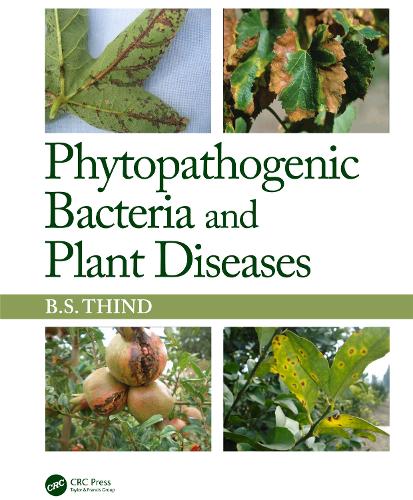
Phytopathogenic Bacteria and Plant Diseases
The field of Phytobacteriology is rapidly advancing and changing, due to recent advances in genomics and molecular plant pathology, as well as the global spread of bacterial plant diseases and the emergence of new bacterial diseases. There is a need to integrate an understanding of bacterial taxonomy, genomics, and basic plant pathology that reflects state-of-the-art knowledge about plant-disease mechanisms.
Phytopathogenic Bacteria and Plant Diseases describes seventy specific bacterial plant diseases and presents an up-to-date classification of plant pathogenic bacteria. It serves as a valuable resource for scientists and researchers engaged in ongoing projects or formulation of new research projects. The book is also suitable as a textbook for advanced undergraduate and postgraduate students in the disciplines of Phytobacteriology and Plant Pathology.
Key features of the book include:
- Contains the latest updated information on plant pathogenic bacteria up to December 2018.
- Describes seventy specific bacterial diseases.
- Presents classification of the bacteria and associated nomenclature based on Bergey’s Manual Systematic Bacteriology and International Journal of Systematic and Evolutionary Microbiology.
- Discusses practical and thoroughly tested disease management strategies to help control significant losses caused by these plant diseases.
- Reviews the role of Type I-VI secretion systems and peptide- or protein-containing toxins produced by bacterial plant pathogens.
- Briefs on plants and plant products that act as carriers of human enteric bacterial pathogens, emphasizing the role of seed sprouts as common vehicles causing food-borne illness.
Dr B. S. Thind, former Professor-cum-Head of the Department of Plant Pathology at Punjab Agricultural University, Ludhiana, India, brings 34 years of experience in teaching, research, and technology transfer. He has conducted research on bacterial blight of rice, bacterial stalk rot of maize, bacterial blight of cowpea, bacterial leaf spot of green gram, bacterial leaf spot of chillies, and bacterial soft rot of potatoes. Dr Thind served as Principal Investigator of two ICAR-funded research schemes and a DST funded research scheme focusing on various aspects of phytopathogenic bacteria and disease control.
He authored a manual entitled "Plant Bacteriology" and a textbook entitled "Phytopathogenic Procaryotes and Plant Diseases," published by Scientific Publishers (India). He is a life member of the Indian Phytopathological Society, Indian Society of Plant Pathologists, Indian Society of Mycology and Plant Pathology, and the Indian Science Congress Association.
The field of Phytobacteriology is rapidly advancing and changing, due to recent advances in genomics and molecular plant pathology, as well as the global spread of bacterial plant diseases and the emergence of new bacterial diseases. There is a need to integrate an understanding of bacterial taxonomy, genomics, and basic plant pathology that reflects state-of-the-art knowledge about plant-disease mechanisms.
Phytopathogenic Bacteria and Plant Diseases describes seventy specific bacterial plant diseases and presents an up-to-date classification of plant pathogenic bacteria. It serves as a valuable resource for scientists and researchers engaged in ongoing projects or formulation of new research projects. The book is also suitable as a textbook for advanced undergraduate and postgraduate students in the disciplines of Phytobacteriology and Plant Pathology.
Key features of the book include:
- Contains the latest updated information on plant pathogenic bacteria up to December 2018.
- Describes seventy specific bacterial diseases.
- Presents classification of the bacteria and associated nomenclature based on Bergey’s Manual Systematic Bacteriology and International Journal of Systematic and Evolutionary Microbiology.
- Discusses practical and thoroughly tested disease management strategies to help control significant losses caused by these plant diseases.
- Reviews the role of Type I-VI secretion systems and peptide- or protein-containing toxins produced by bacterial plant pathogens.
- Briefs on plants and plant products that act as carriers of human enteric bacterial pathogens, emphasizing the role of seed sprouts as common vehicles causing food-borne illness.
Dr B. S. Thind, former Professor-cum-Head of the Department of Plant Pathology at Punjab Agricultural University, Ludhiana, India, brings 34 years of experience in teaching, research, and technology transfer. He has conducted research on bacterial blight of rice, bacterial stalk rot of maize, bacterial blight of cowpea, bacterial leaf spot of green gram, bacterial leaf spot of chillies, and bacterial soft rot of potatoes. Dr Thind served as Principal Investigator of two ICAR-funded research schemes and a DST funded research scheme focusing on various aspects of phytopathogenic bacteria and disease control.
He authored a manual entitled "Plant Bacteriology" and a textbook entitled "Phytopathogenic Procaryotes and Plant Diseases," published by Scientific Publishers (India). He is a life member of the Indian Phytopathological Society, Indian Society of Plant Pathologists, Indian Society of Mycology and Plant Pathology, and the Indian Science Congress Association.
Description
The field of Phytobacteriology is rapidly advancing and changing, due to recent advances in genomics and molecular plant pathology, as well as the global spread of bacterial plant diseases and the emergence of new bacterial diseases. There is a need to integrate an understanding of bacterial taxonomy, genomics, and basic plant pathology that reflects state-of-the-art knowledge about plant-disease mechanisms.
Phytopathogenic Bacteria and Plant Diseases describes seventy specific bacterial plant diseases and presents an up-to-date classification of plant pathogenic bacteria. It serves as a valuable resource for scientists and researchers engaged in ongoing projects or formulation of new research projects. The book is also suitable as a textbook for advanced undergraduate and postgraduate students in the disciplines of Phytobacteriology and Plant Pathology.
Key features of the book include:
- Contains the latest updated information on plant pathogenic bacteria up to December 2018.
- Describes seventy specific bacterial diseases.
- Presents classification of the bacteria and associated nomenclature based on Bergey’s Manual Systematic Bacteriology and International Journal of Systematic and Evolutionary Microbiology.
- Discusses practical and thoroughly tested disease management strategies to help control significant losses caused by these plant diseases.
- Reviews the role of Type I-VI secretion systems and peptide- or protein-containing toxins produced by bacterial plant pathogens.
- Briefs on plants and plant products that act as carriers of human enteric bacterial pathogens, emphasizing the role of seed sprouts as common vehicles causing food-borne illness.
Dr B. S. Thind, former Professor-cum-Head of the Department of Plant Pathology at Punjab Agricultural University, Ludhiana, India, brings 34 years of experience in teaching, research, and technology transfer. He has conducted research on bacterial blight of rice, bacterial stalk rot of maize, bacterial blight of cowpea, bacterial leaf spot of green gram, bacterial leaf spot of chillies, and bacterial soft rot of potatoes. Dr Thind served as Principal Investigator of two ICAR-funded research schemes and a DST funded research scheme focusing on various aspects of phytopathogenic bacteria and disease control.
He authored a manual entitled "Plant Bacteriology" and a textbook entitled "Phytopathogenic Procaryotes and Plant Diseases," published by Scientific Publishers (India). He is a life member of the Indian Phytopathological Society, Indian Society of Plant Pathologists, Indian Society of Mycology and Plant Pathology, and the Indian Science Congress Association.