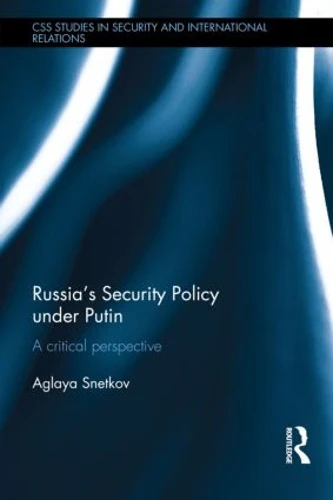
Russia's Security Policy under Putin
This book examines the evolution of Russia’s security policy under Putin in the 21st century, using a critical security studies approach.
Drawing on critical approaches to security, the book investigates the interrelationship between the internal-external nexus and the politics of (in)security and regime-building in Putin’s Russia. It evaluates the way this evolving relationship between state identities and security discourses framed the construction of individual security policies, and how, in turn, individual issues can impact the meta-discourses of state and security agendas. To this end, the (de)securitisation discourses and practices towards the issue of Chechnya are examined as a case study.
This study has wider implications for how we read Russia as a security actor through an approach that emphasises the importance of considering its security culture and the interconnection between internal and external security priorities. It highlights the dramatic changes that have occurred in Russia’s conceptions of itself, national and security priorities, and the conceptualisation of key security issues, such as Chechnya. These aspects of Russia’s security agenda remain somewhat neglected in research, but as argued in Russia's Security Policy under Putin, they offer structuring and framing implications for how we understand Russia’s position towards security issues, and perhaps those of rising powers more broadly.
This book will be of much interest to students of Russian security, critical security studies, and international relations (IR).
This book examines the evolution of Russia’s security policy under Putin in the 21st century, using a critical security studies approach.
Drawing on critical approaches to security, the book investigates the interrelationship between the internal-external nexus and the politics of (in)security and regime-building in Putin’s Russia. It evaluates the way this evolving relationship between state identities and security discourses framed the construction of individual security policies, and how, in turn, individual issues can impact the meta-discourses of state and security agendas. To this end, the (de)securitisation discourses and practices towards the issue of Chechnya are examined as a case study.
This study has wider implications for how we read Russia as a security actor through an approach that emphasises the importance of considering its security culture and the interconnection between internal and external security priorities. It highlights the dramatic changes that have occurred in Russia’s conceptions of itself, national and security priorities, and the conceptualisation of key security issues, such as Chechnya. These aspects of Russia’s security agenda remain somewhat neglected in research, but as argued in Russia's Security Policy under Putin, they offer structuring and framing implications for how we understand Russia’s position towards security issues, and perhaps those of rising powers more broadly.
This book will be of much interest to students of Russian security, critical security studies, and international relations (IR).
Description
This book examines the evolution of Russia’s security policy under Putin in the 21st century, using a critical security studies approach.
Drawing on critical approaches to security, the book investigates the interrelationship between the internal-external nexus and the politics of (in)security and regime-building in Putin’s Russia. It evaluates the way this evolving relationship between state identities and security discourses framed the construction of individual security policies, and how, in turn, individual issues can impact the meta-discourses of state and security agendas. To this end, the (de)securitisation discourses and practices towards the issue of Chechnya are examined as a case study.
This study has wider implications for how we read Russia as a security actor through an approach that emphasises the importance of considering its security culture and the interconnection between internal and external security priorities. It highlights the dramatic changes that have occurred in Russia’s conceptions of itself, national and security priorities, and the conceptualisation of key security issues, such as Chechnya. These aspects of Russia’s security agenda remain somewhat neglected in research, but as argued in Russia's Security Policy under Putin, they offer structuring and framing implications for how we understand Russia’s position towards security issues, and perhaps those of rising powers more broadly.
This book will be of much interest to students of Russian security, critical security studies, and international relations (IR).