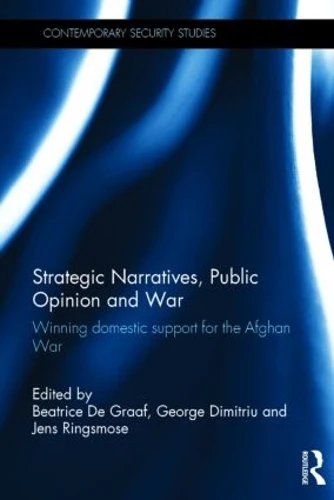
Strategic Narratives, Public Opinion and War
This volume explores the way governments endeavoured to build and maintain public support for the war in Afghanistan, combining new insights on the effects of strategic narratives with an exhaustive series of case studies.
In contemporary wars, with public opinion impacting heavily on outcomes, strategic narratives provide a grid for interpreting the why, what and how of the conflict. Strategic Narratives, Public Opinion and War asks how public support for the deployment of military troops to Afghanistan was garnered, sustained or lost in thirteen contributing nations. Public attitudes in the US, Canada, Australia and Europe towards the use of military force were shaped significantly by the cohesiveness and content of the strategic narratives employed by national policy-makers.
Assessing the ability of countries to craft a successful strategic narrative, the book addresses several key areas: how governments employ strategic narratives to gain public support; how strategic narratives develop during the course of the conflict; how these narratives are disseminated, framed and perceived through various media outlets; how domestic audiences respond to strategic narratives; and how this interplay is conditioned by events on the ground in Afghanistan, and by structural elements of the domestic political systems.
This book will be of much interest to students of international intervention, foreign policy, political communication, international security, strategic studies and International Relations in general.
This volume explores the way governments endeavoured to build and maintain public support for the war in Afghanistan, combining new insights on the effects of strategic narratives with an exhaustive series of case studies.
In contemporary wars, with public opinion impacting heavily on outcomes, strategic narratives provide a grid for interpreting the why, what and how of the conflict. Strategic Narratives, Public Opinion and War asks how public support for the deployment of military troops to Afghanistan was garnered, sustained or lost in thirteen contributing nations. Public attitudes in the US, Canada, Australia and Europe towards the use of military force were shaped significantly by the cohesiveness and content of the strategic narratives employed by national policy-makers.
Assessing the ability of countries to craft a successful strategic narrative, the book addresses several key areas: how governments employ strategic narratives to gain public support; how strategic narratives develop during the course of the conflict; how these narratives are disseminated, framed and perceived through various media outlets; how domestic audiences respond to strategic narratives; and how this interplay is conditioned by events on the ground in Afghanistan, and by structural elements of the domestic political systems.
This book will be of much interest to students of international intervention, foreign policy, political communication, international security, strategic studies and International Relations in general.
Original: $203.48
-65%$203.48
$71.22Description
This volume explores the way governments endeavoured to build and maintain public support for the war in Afghanistan, combining new insights on the effects of strategic narratives with an exhaustive series of case studies.
In contemporary wars, with public opinion impacting heavily on outcomes, strategic narratives provide a grid for interpreting the why, what and how of the conflict. Strategic Narratives, Public Opinion and War asks how public support for the deployment of military troops to Afghanistan was garnered, sustained or lost in thirteen contributing nations. Public attitudes in the US, Canada, Australia and Europe towards the use of military force were shaped significantly by the cohesiveness and content of the strategic narratives employed by national policy-makers.
Assessing the ability of countries to craft a successful strategic narrative, the book addresses several key areas: how governments employ strategic narratives to gain public support; how strategic narratives develop during the course of the conflict; how these narratives are disseminated, framed and perceived through various media outlets; how domestic audiences respond to strategic narratives; and how this interplay is conditioned by events on the ground in Afghanistan, and by structural elements of the domestic political systems.
This book will be of much interest to students of international intervention, foreign policy, political communication, international security, strategic studies and International Relations in general.