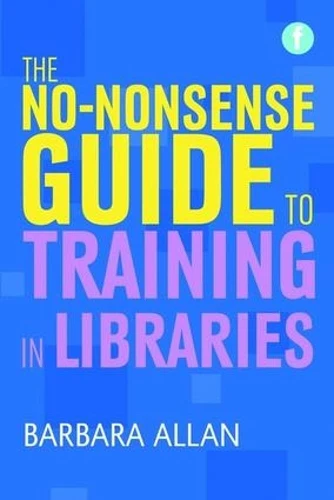
The No-nonsense Guide to Training in Libraries
Straightforward and practical guidance for library and information workers in all sectors who are involved in training users, colleagues, or other groups.
In order to make an impact with their customers, library staff must be well trained and up-to-date. Training is often delivered by library managers, development officers, and trainers who may have limited budgets with access to few resources. This accessible guide uses case studies and examples of best practice from public, school, academic, special, and government libraries to help library and information workers deliver excellent training practice.
Increasingly, library and information staff are being asked to do more and more with fewer resources. In the context of higher education and further education, library and information workers are often involved in training large, diverse groups of more than 100 students, who may have limited resources. In public libraries, library staff may be involved in delivering a wide range of training activities to extremely diverse groups.
Many library and information workers in special libraries deliver end-user and specialist training to busy professionals who are unlikely to have the time to attend pre-scheduled workshops. In addition, the rise of social networking tools and other information and communication technologies has meant that training practices are continually changing to meet the expectations of participants.
The No-nonsense Guide to Training in Libraries provides guidance on the design and delivery of effective training courses and is aimed at helping experienced trainers, as well as those who are still developing their skills, including:
- The people side of training
- Use of technologies to support training practices
- Different approaches to learning and teaching
- Planning and designing training
- Delivering training: face-to-face and blended learning
- Evaluation of training events and continuous improvement
- Learning and development in the workplace
Readership: All library and information workers involved in training.
Straightforward and practical guidance for library and information workers in all sectors who are involved in training users, colleagues, or other groups.
In order to make an impact with their customers, library staff must be well trained and up-to-date. Training is often delivered by library managers, development officers, and trainers who may have limited budgets with access to few resources. This accessible guide uses case studies and examples of best practice from public, school, academic, special, and government libraries to help library and information workers deliver excellent training practice.
Increasingly, library and information staff are being asked to do more and more with fewer resources. In the context of higher education and further education, library and information workers are often involved in training large, diverse groups of more than 100 students, who may have limited resources. In public libraries, library staff may be involved in delivering a wide range of training activities to extremely diverse groups.
Many library and information workers in special libraries deliver end-user and specialist training to busy professionals who are unlikely to have the time to attend pre-scheduled workshops. In addition, the rise of social networking tools and other information and communication technologies has meant that training practices are continually changing to meet the expectations of participants.
The No-nonsense Guide to Training in Libraries provides guidance on the design and delivery of effective training courses and is aimed at helping experienced trainers, as well as those who are still developing their skills, including:
- The people side of training
- Use of technologies to support training practices
- Different approaches to learning and teaching
- Planning and designing training
- Delivering training: face-to-face and blended learning
- Evaluation of training events and continuous improvement
- Learning and development in the workplace
Readership: All library and information workers involved in training.
Original: $102.03
-65%$102.03
$35.71Description
Straightforward and practical guidance for library and information workers in all sectors who are involved in training users, colleagues, or other groups.
In order to make an impact with their customers, library staff must be well trained and up-to-date. Training is often delivered by library managers, development officers, and trainers who may have limited budgets with access to few resources. This accessible guide uses case studies and examples of best practice from public, school, academic, special, and government libraries to help library and information workers deliver excellent training practice.
Increasingly, library and information staff are being asked to do more and more with fewer resources. In the context of higher education and further education, library and information workers are often involved in training large, diverse groups of more than 100 students, who may have limited resources. In public libraries, library staff may be involved in delivering a wide range of training activities to extremely diverse groups.
Many library and information workers in special libraries deliver end-user and specialist training to busy professionals who are unlikely to have the time to attend pre-scheduled workshops. In addition, the rise of social networking tools and other information and communication technologies has meant that training practices are continually changing to meet the expectations of participants.
The No-nonsense Guide to Training in Libraries provides guidance on the design and delivery of effective training courses and is aimed at helping experienced trainers, as well as those who are still developing their skills, including:
- The people side of training
- Use of technologies to support training practices
- Different approaches to learning and teaching
- Planning and designing training
- Delivering training: face-to-face and blended learning
- Evaluation of training events and continuous improvement
- Learning and development in the workplace
Readership: All library and information workers involved in training.