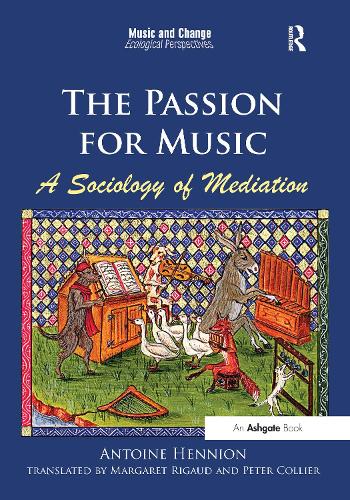
The Passion for Music: A Sociology of Mediation
Music is an accumulation of mediators: instruments, languages, sheets, performers, scenes, media and so on. There is no musical object ‘in itself’; music must always be made again.
In this innovative book, Hennion turns the elusiveness of music into a resource for a pragmatic analysis: by which collective process do we make music appear among us? Rather than offering a sociology of music, The Passion for Music listens to the lesson provided by the case of music—this art of infinite mediations.
Learning from music allows us to transform the paradigm to be offered by sociology by confronting it (from Durkheim and Weber to Bourdieu) with a different way of considering objects. For this task, Hennion draws on aesthetics (Adorno) and art history (Haskell, Baxandall), as well as science and technology studies and popular music studies (Latour, Frith, DeNora).
As part of that project, The Passion for Music presents a wide-ranging series of case studies, restoring attention to the rich and varied intermediaries through which music is brought to life: from the debate around the reinterpretation of baroque music, to the classroom, the rock scene, the classical music concert, Bach’s ‘social career’ in the nineteenth and twentieth centuries, and the practices of music ‘amateurs’ today.
This is the first English translation of one of the most important works of French scholarship on music and society.
Music is an accumulation of mediators: instruments, languages, sheets, performers, scenes, media and so on. There is no musical object ‘in itself’; music must always be made again.
In this innovative book, Hennion turns the elusiveness of music into a resource for a pragmatic analysis: by which collective process do we make music appear among us? Rather than offering a sociology of music, The Passion for Music listens to the lesson provided by the case of music—this art of infinite mediations.
Learning from music allows us to transform the paradigm to be offered by sociology by confronting it (from Durkheim and Weber to Bourdieu) with a different way of considering objects. For this task, Hennion draws on aesthetics (Adorno) and art history (Haskell, Baxandall), as well as science and technology studies and popular music studies (Latour, Frith, DeNora).
As part of that project, The Passion for Music presents a wide-ranging series of case studies, restoring attention to the rich and varied intermediaries through which music is brought to life: from the debate around the reinterpretation of baroque music, to the classroom, the rock scene, the classical music concert, Bach’s ‘social career’ in the nineteenth and twentieth centuries, and the practices of music ‘amateurs’ today.
This is the first English translation of one of the most important works of French scholarship on music and society.
Description
Music is an accumulation of mediators: instruments, languages, sheets, performers, scenes, media and so on. There is no musical object ‘in itself’; music must always be made again.
In this innovative book, Hennion turns the elusiveness of music into a resource for a pragmatic analysis: by which collective process do we make music appear among us? Rather than offering a sociology of music, The Passion for Music listens to the lesson provided by the case of music—this art of infinite mediations.
Learning from music allows us to transform the paradigm to be offered by sociology by confronting it (from Durkheim and Weber to Bourdieu) with a different way of considering objects. For this task, Hennion draws on aesthetics (Adorno) and art history (Haskell, Baxandall), as well as science and technology studies and popular music studies (Latour, Frith, DeNora).
As part of that project, The Passion for Music presents a wide-ranging series of case studies, restoring attention to the rich and varied intermediaries through which music is brought to life: from the debate around the reinterpretation of baroque music, to the classroom, the rock scene, the classical music concert, Bach’s ‘social career’ in the nineteenth and twentieth centuries, and the practices of music ‘amateurs’ today.
This is the first English translation of one of the most important works of French scholarship on music and society.