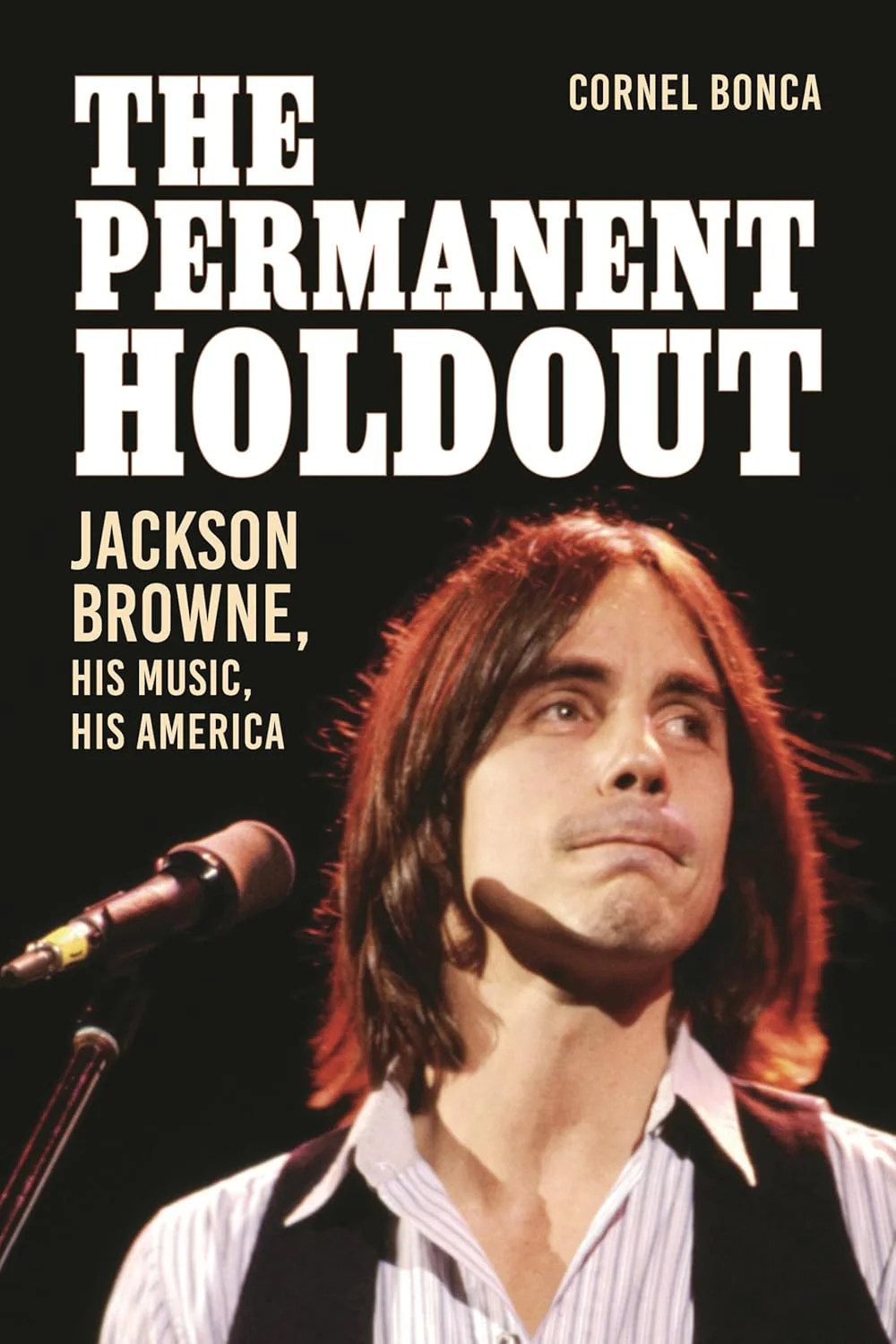
The Permanent Holdout
Known for albums like Late for the Sky, The Pretender, and Running on Empty, Jackson Browne was a master of capturing the counterculture ethos of the 1960s. Cornel Bonca dives deeply into his music, his long fifty-year career, and activism—including environmentalism—within the context of American life, revealing a figure still fuelled by certain American ideals like justice, freedom, and equality for all.
Browne grew up in Southern California in the early 1960s, greatly influenced by his mother’s progressive politics, the music of Bob Dylan, and the speeches of Martin Luther King. Drawn to the Laurel Canyon rock scene, he moved to Los Angeles and established himself as a songwriter for The Eagles, Linda Ronstadt, and many others, becoming a fixture of the singer-songwriter movement in the early 1970s.
His music in the 1980s was largely political in scope, critiquing America’s conservative turn, its militarism in Central America, its nuclear brinkmanship with the Soviet Union, and its dismantling of Great Society social programs. He only returned to the personal music his fans treasured in 1993 with I’m Alive.
Since then, Browne’s music has toggled back and forth between the personal and the political. He’s settled down into a long-term relationship with environmental activist Dianna Cohen and remained astonishingly active in local and national politics. This book dives into his music, life, and political activism in the changing face of America over the last fifty years, and why he still matters today.
Known for albums like Late for the Sky, The Pretender, and Running on Empty, Jackson Browne was a master of capturing the counterculture ethos of the 1960s. Cornel Bonca dives deeply into his music, his long fifty-year career, and activism—including environmentalism—within the context of American life, revealing a figure still fuelled by certain American ideals like justice, freedom, and equality for all.
Browne grew up in Southern California in the early 1960s, greatly influenced by his mother’s progressive politics, the music of Bob Dylan, and the speeches of Martin Luther King. Drawn to the Laurel Canyon rock scene, he moved to Los Angeles and established himself as a songwriter for The Eagles, Linda Ronstadt, and many others, becoming a fixture of the singer-songwriter movement in the early 1970s.
His music in the 1980s was largely political in scope, critiquing America’s conservative turn, its militarism in Central America, its nuclear brinkmanship with the Soviet Union, and its dismantling of Great Society social programs. He only returned to the personal music his fans treasured in 1993 with I’m Alive.
Since then, Browne’s music has toggled back and forth between the personal and the political. He’s settled down into a long-term relationship with environmental activist Dianna Cohen and remained astonishingly active in local and national politics. This book dives into his music, life, and political activism in the changing face of America over the last fifty years, and why he still matters today.
Description
Known for albums like Late for the Sky, The Pretender, and Running on Empty, Jackson Browne was a master of capturing the counterculture ethos of the 1960s. Cornel Bonca dives deeply into his music, his long fifty-year career, and activism—including environmentalism—within the context of American life, revealing a figure still fuelled by certain American ideals like justice, freedom, and equality for all.
Browne grew up in Southern California in the early 1960s, greatly influenced by his mother’s progressive politics, the music of Bob Dylan, and the speeches of Martin Luther King. Drawn to the Laurel Canyon rock scene, he moved to Los Angeles and established himself as a songwriter for The Eagles, Linda Ronstadt, and many others, becoming a fixture of the singer-songwriter movement in the early 1970s.
His music in the 1980s was largely political in scope, critiquing America’s conservative turn, its militarism in Central America, its nuclear brinkmanship with the Soviet Union, and its dismantling of Great Society social programs. He only returned to the personal music his fans treasured in 1993 with I’m Alive.
Since then, Browne’s music has toggled back and forth between the personal and the political. He’s settled down into a long-term relationship with environmental activist Dianna Cohen and remained astonishingly active in local and national politics. This book dives into his music, life, and political activism in the changing face of America over the last fifty years, and why he still matters today.