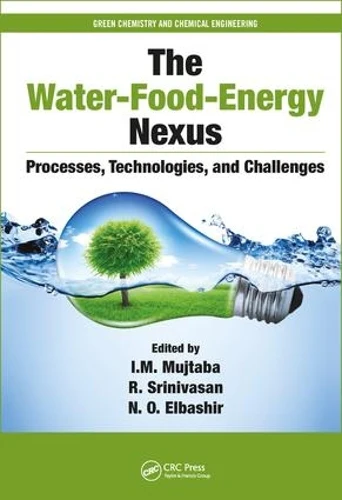
The Water-Food-Energy Nexus
Exponential growth of the worldwide population requires increasing amounts of water, food, and energy. However, as the quantity of available fresh water and energy sources, which directly affect the cost of food production and transportation, diminishes, technological solutions are necessary to secure sustainable supplies.
In direct response to this reality, The Water-Food-Energy Nexus focuses on the water-energy-food nexus and describes in depth the challenges and processes involved in efficient water and energy production and management, wastewater treatment, and impact upon food and essential commodities.
The book is organised into four sections: water, food, energy, and the future of sustainability, highlighting the interplay among these topics.
The first section emphasises water desalination, water management, and wastewater treatment. The second section discusses cereal processing, sustainable food security, bioenergy in food production, water and energy consumption in food processing, and mathematical modelling for food undergoing phase changes.
The third section explores fossil fuels, biofuels, synthetic fuels, renewable energy, and carbon capture. Finally, the book concludes with a discussion of the future of sustainability, including the role of molecular thermodynamics in developing processes and products, green engineering in process systems, petrochemical water splitting, petrochemical approaches to solar hydrogen generation, design and operation strategy of energy-efficient processes, and the sustainability of processes, supply chain, and enterprise.
Exponential growth of the worldwide population requires increasing amounts of water, food, and energy. However, as the quantity of available fresh water and energy sources, which directly affect the cost of food production and transportation, diminishes, technological solutions are necessary to secure sustainable supplies.
In direct response to this reality, The Water-Food-Energy Nexus focuses on the water-energy-food nexus and describes in depth the challenges and processes involved in efficient water and energy production and management, wastewater treatment, and impact upon food and essential commodities.
The book is organised into four sections: water, food, energy, and the future of sustainability, highlighting the interplay among these topics.
The first section emphasises water desalination, water management, and wastewater treatment. The second section discusses cereal processing, sustainable food security, bioenergy in food production, water and energy consumption in food processing, and mathematical modelling for food undergoing phase changes.
The third section explores fossil fuels, biofuels, synthetic fuels, renewable energy, and carbon capture. Finally, the book concludes with a discussion of the future of sustainability, including the role of molecular thermodynamics in developing processes and products, green engineering in process systems, petrochemical water splitting, petrochemical approaches to solar hydrogen generation, design and operation strategy of energy-efficient processes, and the sustainability of processes, supply chain, and enterprise.
Description
Exponential growth of the worldwide population requires increasing amounts of water, food, and energy. However, as the quantity of available fresh water and energy sources, which directly affect the cost of food production and transportation, diminishes, technological solutions are necessary to secure sustainable supplies.
In direct response to this reality, The Water-Food-Energy Nexus focuses on the water-energy-food nexus and describes in depth the challenges and processes involved in efficient water and energy production and management, wastewater treatment, and impact upon food and essential commodities.
The book is organised into four sections: water, food, energy, and the future of sustainability, highlighting the interplay among these topics.
The first section emphasises water desalination, water management, and wastewater treatment. The second section discusses cereal processing, sustainable food security, bioenergy in food production, water and energy consumption in food processing, and mathematical modelling for food undergoing phase changes.
The third section explores fossil fuels, biofuels, synthetic fuels, renewable energy, and carbon capture. Finally, the book concludes with a discussion of the future of sustainability, including the role of molecular thermodynamics in developing processes and products, green engineering in process systems, petrochemical water splitting, petrochemical approaches to solar hydrogen generation, design and operation strategy of energy-efficient processes, and the sustainability of processes, supply chain, and enterprise.