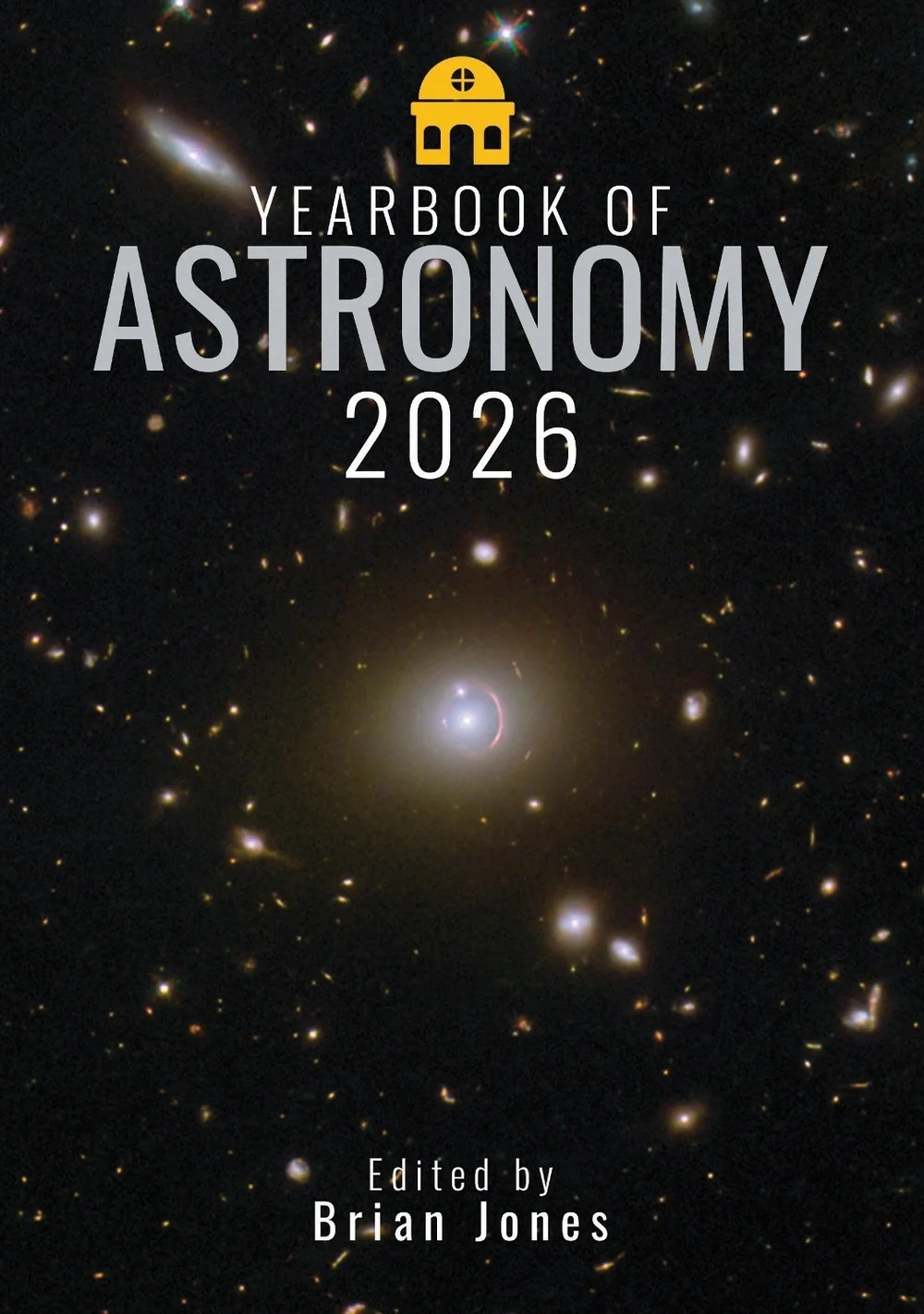
Yearbook of Astronomy 2026
Maintaining its appealing style and presentation, the Yearbook of Astronomy 2026 contains comprehensive jargon-free monthly sky notes and an authoritative set of sky charts to enable backyard astronomers and sky gazers everywhere to plan their viewing of the year's eclipses, comets, meteor showers and minor planets. It also details the phases of the Moon and visibility and locations of the planets throughout the year.
To supplement all this, the Yearbook of Astronomy 2026 features a variety of entertaining and informative articles, a hallmark of the publication. Presenting readers with information on a wide range of topics, the articles for the 2026 edition include, among others:
- Recent Advances in Astronomy
- Recent Advances in Solar System Exploration
- Anniversaries in 2026
- The Astronomers' Stars: Taking It to Extremes
- Hawking Stars
- Subrahmanyan Chandrasekhar and Professor A. S. Eddington
- Planetary Protection
- Nearby Worlds Out There: The Many Kinds of Exoplanet
- Comets and Literature in the Nineteenth Century
- On the Origin of NASA Names
- Mission to Mars: Countdown to Building a Brave New World: Pausing for Thought
- A History of Observatory Designs: The Telescope Age
- Sidewalk Astronomy: Cosmos to Kerbside
This iconic publication made its first appearance way back in 1962, shortly after the dawning of the Space Age. Now well into its seventh decade of production, the Yearbook continues to be essential reading for anyone lured and fascinated by the magic of astronomy, and who has a desire to extend their knowledge of the Universe and the wonders to which it plays host. The Yearbook of Astronomy is indeed an inspiration to amateur and professional astronomers alike, and warrants a place on the bookshelf of all stargazers and watchers of the skies.
AUTHOR: Brian Jones hails from Bradford in the West Riding of Yorkshire and was a founder member of the Bradford Astronomical Society. He developed a fascination for astronomy at the age of five when he first saw the stars through a pair of binoculars. His interest led him to write sky guides for local newspapers, appear on local radio and television, teach astronomy and space in schools, and, in 1985, become a full-time astronomy and space writer.
Since 2017, Brian has been the editor of the Yearbook of Astronomy and has penned around 20 books to date, covering a wide range of astronomy- and space-related topics for both children and adults. His passion for bringing an appreciation of the universe to his readers is reflected in his writing. The minor planet 45689 Brianjones is named after him.
100 colour illustrations
Maintaining its appealing style and presentation, the Yearbook of Astronomy 2026 contains comprehensive jargon-free monthly sky notes and an authoritative set of sky charts to enable backyard astronomers and sky gazers everywhere to plan their viewing of the year's eclipses, comets, meteor showers and minor planets. It also details the phases of the Moon and visibility and locations of the planets throughout the year.
To supplement all this, the Yearbook of Astronomy 2026 features a variety of entertaining and informative articles, a hallmark of the publication. Presenting readers with information on a wide range of topics, the articles for the 2026 edition include, among others:
- Recent Advances in Astronomy
- Recent Advances in Solar System Exploration
- Anniversaries in 2026
- The Astronomers' Stars: Taking It to Extremes
- Hawking Stars
- Subrahmanyan Chandrasekhar and Professor A. S. Eddington
- Planetary Protection
- Nearby Worlds Out There: The Many Kinds of Exoplanet
- Comets and Literature in the Nineteenth Century
- On the Origin of NASA Names
- Mission to Mars: Countdown to Building a Brave New World: Pausing for Thought
- A History of Observatory Designs: The Telescope Age
- Sidewalk Astronomy: Cosmos to Kerbside
This iconic publication made its first appearance way back in 1962, shortly after the dawning of the Space Age. Now well into its seventh decade of production, the Yearbook continues to be essential reading for anyone lured and fascinated by the magic of astronomy, and who has a desire to extend their knowledge of the Universe and the wonders to which it plays host. The Yearbook of Astronomy is indeed an inspiration to amateur and professional astronomers alike, and warrants a place on the bookshelf of all stargazers and watchers of the skies.
AUTHOR: Brian Jones hails from Bradford in the West Riding of Yorkshire and was a founder member of the Bradford Astronomical Society. He developed a fascination for astronomy at the age of five when he first saw the stars through a pair of binoculars. His interest led him to write sky guides for local newspapers, appear on local radio and television, teach astronomy and space in schools, and, in 1985, become a full-time astronomy and space writer.
Since 2017, Brian has been the editor of the Yearbook of Astronomy and has penned around 20 books to date, covering a wide range of astronomy- and space-related topics for both children and adults. His passion for bringing an appreciation of the universe to his readers is reflected in his writing. The minor planet 45689 Brianjones is named after him.
100 colour illustrations
Original: $37.47
-65%$37.47
$13.11Description
Maintaining its appealing style and presentation, the Yearbook of Astronomy 2026 contains comprehensive jargon-free monthly sky notes and an authoritative set of sky charts to enable backyard astronomers and sky gazers everywhere to plan their viewing of the year's eclipses, comets, meteor showers and minor planets. It also details the phases of the Moon and visibility and locations of the planets throughout the year.
To supplement all this, the Yearbook of Astronomy 2026 features a variety of entertaining and informative articles, a hallmark of the publication. Presenting readers with information on a wide range of topics, the articles for the 2026 edition include, among others:
- Recent Advances in Astronomy
- Recent Advances in Solar System Exploration
- Anniversaries in 2026
- The Astronomers' Stars: Taking It to Extremes
- Hawking Stars
- Subrahmanyan Chandrasekhar and Professor A. S. Eddington
- Planetary Protection
- Nearby Worlds Out There: The Many Kinds of Exoplanet
- Comets and Literature in the Nineteenth Century
- On the Origin of NASA Names
- Mission to Mars: Countdown to Building a Brave New World: Pausing for Thought
- A History of Observatory Designs: The Telescope Age
- Sidewalk Astronomy: Cosmos to Kerbside
This iconic publication made its first appearance way back in 1962, shortly after the dawning of the Space Age. Now well into its seventh decade of production, the Yearbook continues to be essential reading for anyone lured and fascinated by the magic of astronomy, and who has a desire to extend their knowledge of the Universe and the wonders to which it plays host. The Yearbook of Astronomy is indeed an inspiration to amateur and professional astronomers alike, and warrants a place on the bookshelf of all stargazers and watchers of the skies.
AUTHOR: Brian Jones hails from Bradford in the West Riding of Yorkshire and was a founder member of the Bradford Astronomical Society. He developed a fascination for astronomy at the age of five when he first saw the stars through a pair of binoculars. His interest led him to write sky guides for local newspapers, appear on local radio and television, teach astronomy and space in schools, and, in 1985, become a full-time astronomy and space writer.
Since 2017, Brian has been the editor of the Yearbook of Astronomy and has penned around 20 books to date, covering a wide range of astronomy- and space-related topics for both children and adults. His passion for bringing an appreciation of the universe to his readers is reflected in his writing. The minor planet 45689 Brianjones is named after him.
100 colour illustrations